Specializing in Media Campaigns for the Music Community, Artists, Labels, Venues and Events

slide

Archive of Contemporary Music – Holiday Sale 2016

Archive of Contemporary Music – Holiday Sale 2016


Email not displaying correctly? View it in your browser.acebook Like 


ARC HOLIDAY RECORD + CD SALE!

Sat, Dec 3 and runs through Sun, Dec. 18
open everyday, 11am – 6pm
ARChive of Contemporary Music
54 White Street • Tribeca
Free Admission
 
This is our major fundraiser, so come by and shop
books, CDs, LPs, 45s, VHS, DVDs, sheet music + more
Please Blog, face, tweet, post + shout about our sale…
 
Join ARC + attend our Holiday Sale Party
great food, nice people
+ first crack at all the recordings!
ARC members ONLY, Thursday Dec 1, 6pm
PARTY treats = Champagne and Two Boots Pizza


  JOIN or DONATE to ARC via PayPal or NYCharities 
(212) 226-6967    info@arcmusic.org    arcmusic.org


Unsubscribe   |    Update info   |    Privacy policy   |    Forward email
 
B George sent this message to jim@jazzpromoservices.com
Questions? Contact B George
c/o FanBridge, Inc. – 14525 SW Millikan Way, #16910, Beaverton, Oregon 97005, United States
owered by FanBridge


Jim Eigo Jazz Promo Services T: 845-986-1677 E-Mail: jim@jazzpromoservices.com
http://www.jazzpromoservices.com

HAVE A JAZZ EVENT, NEW CD OR IMPORTANT ANNOUNCEMENT FOR THE JAZZ COMMUNITY YOU WANT TO PROMOTE? CONTACT JAZZ PROMO SERVICES FOR PRICE QUOTE.

CHECK OUT OUR NEW YOUTUBE VIDEO

Unsubscribe | Update your profile | Forward to a friend

PLEASE NOTE: IF YOU DO NOT WISH TO BE ON THIS MAILING LIST PLEASE RESPOND WITH ‘REMOVE’ IN THE SUBJECT LINE. IF YOU ARE RECEIVING DUPLICATE EMAILS OUR APOLOGIES, JAZZ PROMO SERVICES ANNOUNCEMENT LIST IS GROWING LARGER EVERY DAY…..PLEASE LET US KNOW AND WE WILL FIX IT IMMEDIATELY!

Copyright (C) 2016 All rights reserved.

Jazz Promo Services

269 State Route 94 South

Warwick, Ny 10990

Add us to your address book

slide

Los Angeles jazz detective Zev Feldman unearths hidden treasures | Georgia Straight Vancouver’s News

Los Angeles jazz detective Zev Feldman unearths hidden treasures | Georgia Straight Vancouver’s News

http://www.straight.com/music/829826/los-angeles-jazz-detective-zev-feldman-unearths-hidden-treasures
 
Los Angeles jazz detective Zev Feldman unearths hidden treasures
 
by Alexander Varty on November 16th, 2016 at 2:02 PM


1

  • CREATOR: gd-jpeg v1.0 (using IJG JPEG v80), quality = 70
  • [if (lt IE 9) & (!IEMobile)]> <span data-src=”//d2ciprw05cjhos.cloudfront.net/files/v3/styles/gs_standard/public/images/16/11/mus_zevfeldman2_2551.jpg?itok=uBIsF1P3″></span> <![endif]


  •  

Zev Feldman has it easy.

The man Stereophile magazine recently called “the Indiana Jones of jazz” has yet to encounter poisonous spiders, treacherous Nazis, or writhing snakes while in the field—and even if he did, he’d probably brush right by them in his zeal to unearth hidden treasures from dusty archives and musty basements all over Europe and North America.
“I have this really blessed life,” Feldman readily admits, reached at home in Los Angeles. “I spring out of bed in the morning and do things that I really enjoy doing.”
 
And what he most enjoys doing is uncovering overlooked or unheard jazz recordings of significant import. As cofounder of the Elemental Music imprint, for example, Feldman brought 25 long-out-of-print recordings from the defunct Xanadu label back to life, rescuing some of the tapes from an East Coast warehouse flooded by Hurricane Sandy.
And a recent project for Resonance Records, a California nonprofit, sent him—appropriately enough—to Indianapolis, Indiana, where he interviewed friends and associates of the late Wes Montgomery in order to write the liner notes for Echoes of Indiana Avenue, a compilation of previously unreleased recordings featuring some of the jazz-guitar great’s most relaxed yet inspired music.
“That was the beginning of the Jazz Detective,” says Feldman, alluding to another of his nicknames. “I made three trips to Indianapolis and pieced together, with people who were in the know, who was playing on each of those tracks.
“It was an unbelievable experience in jazz archaeology—and then came Bill Evans’s Live at Art D’Lugoff’s Top of the Gate, and those two albums in 2012 did 60,000 copies combined, which made them two of the biggest-selling jazz albums of the year.”
Since then, Feldman has been vetting literally hundreds of historical recordings—mostly for Resonance, where he’s executive vice-president and general manager. Next up for release? A long-lost 1959 studio date by none other than Thelonious Monk.
He’s also been handed the keys to the Radio France archives, and has dibs on a greater treasure than the fabled Ark of the Covenant: 12 hours of music by the artist many consider the best saxophonist of all time. Feldman’s not quite ready to name names, so let’s just say that any jazz fan would consider their release a giant step for humanity.
And, busy as he is, Feldman continues to evangelize for his favourite art form. This week, for instance, he’ll be in Vancouver, hosting a series of concerts in which some of our finest musicians will pay tribute to performers on the Resonance roster.
Saxophonist Steve Kaldestad will interpret the music of Stan Getz and João Gilberto; Chris Gestrin will channel the innovative organist Larry Young; Dave Sikula will reflect on Montgomery, one of his most significant mentors; singer Jaclyn Guillou will do for Shirley Horn what she’s already done for Dinah Washington; and the Capilano University “A” Band will swing its way through the sounds of Thad Jones and Mel Lewis.
Feldman credits Coastal Jazz and Blues Society staffer Cory Weeds—a record-label owner in his own right—with the idea of bringing him to town.
“He’s going to have me talk about what’s involved in doing these historical releases,” he explains. “We’ll have them for sale, and I’ll get a chance to meet people in the jazz community, the fans out there.
“I just really thrive on meeting people who share this passion,” Feldman adds. “And if any of your readers out there have any tapes, I’d love to hear them!”
The Coastal Jazz and Blues Society presents Jazz Legends Lost & Found with Resonance Records at Frankie’s Jazz Club from Thursday to Monday (November 17 to 21).


Jim Eigo Jazz Promo Services T: 845-986-1677 E-Mail: jim@jazzpromoservices.com
http://www.jazzpromoservices.com

HAVE A JAZZ EVENT, NEW CD OR IMPORTANT ANNOUNCEMENT FOR THE JAZZ COMMUNITY YOU WANT TO PROMOTE? CONTACT JAZZ PROMO SERVICES FOR PRICE QUOTE.

CHECK OUT OUR NEW YOUTUBE VIDEO

Unsubscribe | Update your profile | Forward to a friend

PLEASE NOTE: IF YOU DO NOT WISH TO BE ON THIS MAILING LIST PLEASE RESPOND WITH ‘REMOVE’ IN THE SUBJECT LINE. IF YOU ARE RECEIVING DUPLICATE EMAILS OUR APOLOGIES, JAZZ PROMO SERVICES ANNOUNCEMENT LIST IS GROWING LARGER EVERY DAY…..PLEASE LET US KNOW AND WE WILL FIX IT IMMEDIATELY!

Copyright (C) 2016 All rights reserved.

Jazz Promo Services

269 State Route 94 South

Warwick, Ny 10990

Add us to your address book

slide

Los Angeles jazz detective Zev Feldman unearths hidden treasures | Georgia Straight Vancouver’s News

Los Angeles jazz detective Zev Feldman unearths hidden treasures | Georgia Straight Vancouver’s News

http://www.straight.com/music/829826/los-angeles-jazz-detective-zev-feldman-unearths-hidden-treasures
 
Los Angeles jazz detective Zev Feldman unearths hidden treasures
 
by Alexander Varty on November 16th, 2016 at 2:02 PM


1

  • CREATOR: gd-jpeg v1.0 (using IJG JPEG v80), quality = 70
  • [if (lt IE 9) & (!IEMobile)]> <span data-src=”//d2ciprw05cjhos.cloudfront.net/files/v3/styles/gs_standard/public/images/16/11/mus_zevfeldman2_2551.jpg?itok=uBIsF1P3″></span> <![endif]


  •  

Zev Feldman has it easy.

The man Stereophile magazine recently called “the Indiana Jones of jazz” has yet to encounter poisonous spiders, treacherous Nazis, or writhing snakes while in the field—and even if he did, he’d probably brush right by them in his zeal to unearth hidden treasures from dusty archives and musty basements all over Europe and North America.
“I have this really blessed life,” Feldman readily admits, reached at home in Los Angeles. “I spring out of bed in the morning and do things that I really enjoy doing.”
 
And what he most enjoys doing is uncovering overlooked or unheard jazz recordings of significant import. As cofounder of the Elemental Music imprint, for example, Feldman brought 25 long-out-of-print recordings from the defunct Xanadu label back to life, rescuing some of the tapes from an East Coast warehouse flooded by Hurricane Sandy.
And a recent project for Resonance Records, a California nonprofit, sent him—appropriately enough—to Indianapolis, Indiana, where he interviewed friends and associates of the late Wes Montgomery in order to write the liner notes for Echoes of Indiana Avenue, a compilation of previously unreleased recordings featuring some of the jazz-guitar great’s most relaxed yet inspired music.
“That was the beginning of the Jazz Detective,” says Feldman, alluding to another of his nicknames. “I made three trips to Indianapolis and pieced together, with people who were in the know, who was playing on each of those tracks.
“It was an unbelievable experience in jazz archaeology—and then came Bill Evans’s Live at Art D’Lugoff’s Top of the Gate, and those two albums in 2012 did 60,000 copies combined, which made them two of the biggest-selling jazz albums of the year.”
Since then, Feldman has been vetting literally hundreds of historical recordings—mostly for Resonance, where he’s executive vice-president and general manager. Next up for release? A long-lost 1959 studio date by none other than Thelonious Monk.
He’s also been handed the keys to the Radio France archives, and has dibs on a greater treasure than the fabled Ark of the Covenant: 12 hours of music by the artist many consider the best saxophonist of all time. Feldman’s not quite ready to name names, so let’s just say that any jazz fan would consider their release a giant step for humanity.
And, busy as he is, Feldman continues to evangelize for his favourite art form. This week, for instance, he’ll be in Vancouver, hosting a series of concerts in which some of our finest musicians will pay tribute to performers on the Resonance roster.
Saxophonist Steve Kaldestad will interpret the music of Stan Getz and João Gilberto; Chris Gestrin will channel the innovative organist Larry Young; Dave Sikula will reflect on Montgomery, one of his most significant mentors; singer Jaclyn Guillou will do for Shirley Horn what she’s already done for Dinah Washington; and the Capilano University “A” Band will swing its way through the sounds of Thad Jones and Mel Lewis.
Feldman credits Coastal Jazz and Blues Society staffer Cory Weeds—a record-label owner in his own right—with the idea of bringing him to town.
“He’s going to have me talk about what’s involved in doing these historical releases,” he explains. “We’ll have them for sale, and I’ll get a chance to meet people in the jazz community, the fans out there.
“I just really thrive on meeting people who share this passion,” Feldman adds. “And if any of your readers out there have any tapes, I’d love to hear them!”
The Coastal Jazz and Blues Society presents Jazz Legends Lost & Found with Resonance Records at Frankie’s Jazz Club from Thursday to Monday (November 17 to 21).


Jim Eigo Jazz Promo Services T: 845-986-1677 E-Mail: jim@jazzpromoservices.com
http://www.jazzpromoservices.com

HAVE A JAZZ EVENT, NEW CD OR IMPORTANT ANNOUNCEMENT FOR THE JAZZ COMMUNITY YOU WANT TO PROMOTE? CONTACT JAZZ PROMO SERVICES FOR PRICE QUOTE.

CHECK OUT OUR NEW YOUTUBE VIDEO

Unsubscribe | Update your profile | Forward to a friend

PLEASE NOTE: IF YOU DO NOT WISH TO BE ON THIS MAILING LIST PLEASE RESPOND WITH ‘REMOVE’ IN THE SUBJECT LINE. IF YOU ARE RECEIVING DUPLICATE EMAILS OUR APOLOGIES, JAZZ PROMO SERVICES ANNOUNCEMENT LIST IS GROWING LARGER EVERY DAY…..PLEASE LET US KNOW AND WE WILL FIX IT IMMEDIATELY!

Copyright (C) 2016 All rights reserved.

Jazz Promo Services

269 State Route 94 South

Warwick, Ny 10990

Add us to your address book

slide

Jazz Radio Host Tom Hampson Has Died | WXXI News

Jazz Radio Host Tom Hampson Has Died | WXXI News

http://wxxinews.org/post/jazz-radio-host-tom-hampson-has-died
 
Jazz Radio Host Tom Hampson Has Died
By RANDY GORBMAN NOV 10, 2016
 
WXXI’s Randy Gorbman talks about the life of local jazz radio host Tom Hampson who died this week.
 
A fixture in local radio and jazz programming has died.
 
Tom Hampson loved jazz since he was a teenager, and he kept that passion even after he chose the law as a career, becoming an attorney specializing in corporate law. He also hosted a weekly jazz show on WXXI for more than 30 years; it was originally called Mostly Jazz, and most recently has been known as Jazz from the Cellar.
 
He died this week at the age of 87, but had been recording the show in his home studio until just the last several weeks.
 <img src=”http://wxxinews.org/sites/wxxi/files/styles/default/public/201611/tom_hampson_edit.jpg” alt=””>

Tom spoke about the longevity of his show earlier this year.
Well, it seems unlikely but it’s true. Here I am about to begin my 57th year of playing jazz on the radio in Rochester. And during that time one of my principal roles has been as a cheerleader of many of the vibrant jazz players in Rochester. And as I say it’s been my privilege to provide air time for some of them.”
Former WXXI program manager and current host on Classical 91.5, Marianne Carberry  says Hampson was just a great guy to work with.
“He was just such a total gentleman and so generous with his time and with his knowledge and you just had a sense of his passion for jazz. He always just took that extra time to answer your questions or share his enthusiasm.”
Hampson knew and interviewed a whole host of both local and internationally famous musicians, including the jazz pianist Marian McPartland, who he also did legal work for, as well as the composer Alec Wilder.
There is no  funeral planned, but his family says there will be a memorial service for him sometime early next year. 


Jim Eigo Jazz Promo Services T: 845-986-1677 E-Mail: jim@jazzpromoservices.com
http://www.jazzpromoservices.com

HAVE A JAZZ EVENT, NEW CD OR IMPORTANT ANNOUNCEMENT FOR THE JAZZ COMMUNITY YOU WANT TO PROMOTE? CONTACT JAZZ PROMO SERVICES FOR PRICE QUOTE.

CHECK OUT OUR NEW YOUTUBE VIDEO

Unsubscribe | Update your profile | Forward to a friend

PLEASE NOTE: IF YOU DO NOT WISH TO BE ON THIS MAILING LIST PLEASE RESPOND WITH ‘REMOVE’ IN THE SUBJECT LINE. IF YOU ARE RECEIVING DUPLICATE EMAILS OUR APOLOGIES, JAZZ PROMO SERVICES ANNOUNCEMENT LIST IS GROWING LARGER EVERY DAY…..PLEASE LET US KNOW AND WE WILL FIX IT IMMEDIATELY!

Copyright (C) 2016 All rights reserved.

Jazz Promo Services

269 State Route 94 South

Warwick, Ny 10990

Add us to your address book

slide

Jazz Radio Host Tom Hampson Has Died | WXXI News

Jazz Radio Host Tom Hampson Has Died | WXXI News

http://wxxinews.org/post/jazz-radio-host-tom-hampson-has-died
 
Jazz Radio Host Tom Hampson Has Died
By RANDY GORBMAN NOV 10, 2016
 
WXXI’s Randy Gorbman talks about the life of local jazz radio host Tom Hampson who died this week.
 
A fixture in local radio and jazz programming has died.
 
Tom Hampson loved jazz since he was a teenager, and he kept that passion even after he chose the law as a career, becoming an attorney specializing in corporate law. He also hosted a weekly jazz show on WXXI for more than 30 years; it was originally called Mostly Jazz, and most recently has been known as Jazz from the Cellar.
 
He died this week at the age of 87, but had been recording the show in his home studio until just the last several weeks.
 <img src=”http://wxxinews.org/sites/wxxi/files/styles/default/public/201611/tom_hampson_edit.jpg” alt=””>
Tom spoke about the longevity of his show earlier this year.
Well, it seems unlikely but it’s true. Here I am about to begin my 57th year of playing jazz on the radio in Rochester. And during that time one of my principal roles has been as a cheerleader of many of the vibrant jazz players in Rochester. And as I say it’s been my privilege to provide air time for some of them.”
Former WXXI program manager and current host on Classical 91.5, Marianne Carberry  says Hampson was just a great guy to work with.
“He was just such a total gentleman and so generous with his time and with his knowledge and you just had a sense of his passion for jazz. He always just took that extra time to answer your questions or share his enthusiasm.”
Hampson knew and interviewed a whole host of both local and internationally famous musicians, including the jazz pianist Marian McPartland, who he also did legal work for, as well as the composer Alec Wilder.
There is no  funeral planned, but his family says there will be a memorial service for him sometime early next year. 


Jim Eigo Jazz Promo Services T: 845-986-1677 E-Mail: jim@jazzpromoservices.com
http://www.jazzpromoservices.com

HAVE A JAZZ EVENT, NEW CD OR IMPORTANT ANNOUNCEMENT FOR THE JAZZ COMMUNITY YOU WANT TO PROMOTE? CONTACT JAZZ PROMO SERVICES FOR PRICE QUOTE.

CHECK OUT OUR NEW YOUTUBE VIDEO

Unsubscribe | Update your profile | Forward to a friend

PLEASE NOTE: IF YOU DO NOT WISH TO BE ON THIS MAILING LIST PLEASE RESPOND WITH ‘REMOVE’ IN THE SUBJECT LINE. IF YOU ARE RECEIVING DUPLICATE EMAILS OUR APOLOGIES, JAZZ PROMO SERVICES ANNOUNCEMENT LIST IS GROWING LARGER EVERY DAY…..PLEASE LET US KNOW AND WE WILL FIX IT IMMEDIATELY!

Copyright (C) 2016 All rights reserved.

Jazz Promo Services

269 State Route 94 South

Warwick, Ny 10990

Add us to your address book

slide

Jazz Piano Workshop 1965 Jaki Byard – YouTube

Jazz Piano Workshop 1965 Jaki Byard – YouTube

https://www.youtube.com/watch?v=mhBFk54qBNk


Jim Eigo Jazz Promo Services T: 845-986-1677 E-Mail: jim@jazzpromoservices.com
http://www.jazzpromoservices.com

HAVE A JAZZ EVENT, NEW CD OR IMPORTANT ANNOUNCEMENT FOR THE JAZZ COMMUNITY YOU WANT TO PROMOTE? CONTACT JAZZ PROMO SERVICES FOR PRICE QUOTE.

CHECK OUT OUR NEW YOUTUBE VIDEO

Unsubscribe | Update your profile | Forward to a friend

PLEASE NOTE: IF YOU DO NOT WISH TO BE ON THIS MAILING LIST PLEASE RESPOND WITH ‘REMOVE’ IN THE SUBJECT LINE. IF YOU ARE RECEIVING DUPLICATE EMAILS OUR APOLOGIES, JAZZ PROMO SERVICES ANNOUNCEMENT LIST IS GROWING LARGER EVERY DAY…..PLEASE LET US KNOW AND WE WILL FIX IT IMMEDIATELY!

Copyright (C) 2016 All rights reserved.

Jazz Promo Services

269 State Route 94 South

Warwick, Ny 10990

Add us to your address book

slide

Jazz Piano Workshop 1965 Jaki Byard – YouTube

Jazz Piano Workshop 1965 Jaki Byard – YouTube

https://www.youtube.com/watch?v=mhBFk54qBNk


Jim Eigo Jazz Promo Services T: 845-986-1677 E-Mail: jim@jazzpromoservices.com
http://www.jazzpromoservices.com

HAVE A JAZZ EVENT, NEW CD OR IMPORTANT ANNOUNCEMENT FOR THE JAZZ COMMUNITY YOU WANT TO PROMOTE? CONTACT JAZZ PROMO SERVICES FOR PRICE QUOTE.

CHECK OUT OUR NEW YOUTUBE VIDEO

Unsubscribe | Update your profile | Forward to a friend

PLEASE NOTE: IF YOU DO NOT WISH TO BE ON THIS MAILING LIST PLEASE RESPOND WITH ‘REMOVE’ IN THE SUBJECT LINE. IF YOU ARE RECEIVING DUPLICATE EMAILS OUR APOLOGIES, JAZZ PROMO SERVICES ANNOUNCEMENT LIST IS GROWING LARGER EVERY DAY…..PLEASE LET US KNOW AND WE WILL FIX IT IMMEDIATELY!

Copyright (C) 2016 All rights reserved.

Jazz Promo Services

269 State Route 94 South

Warwick, Ny 10990

Add us to your address book

slide

Passings: Doug Edwards of Skylark, Chilliwack (1946 – 2016) ~ VVN Music

Passings: Doug Edwards of Skylark, Chilliwack (1946 – 2016) ~ VVN Music

http://www.vintagevinylnews.com/2016/11/passings-doug-edwards-of-skylark.html
 
Passings: Doug Edwards of Skylark, Chilliwack (1946 – 2016)
 
7:16 PM  Doug Edwards, Passings, Pop, Rock, Skylark  No comments

by VVN Music
 
Doug Edwards, the guitarist for Skylark and co-writer of their hit Wildflower, has died at his home in Vancouver after a long illness. He was 71.
 
Producer David Foster, who was a bandmate in Skylark, said “He was, always has been and probably always will be the best ‘pop’ musician Victoria has ever produced — a one in a million.”
 
Edwards was born in Edmonton and moved with his family to Victoria at the age 15 where he took up playing both the guitar and bass. After graduating from high school, he spent some time as the guitarist for the 5th Dimension before joining a band that would become Skylark.
 
Early in their career, he took a poem written by David Richardson and set it to music, becoming the hit Wildflower. Recorded with Doug playing the famous guitar intro, the song went to number 9 on the Hot 100 and 10 in Canada along with topping that country’s Adult Contemporary chart. While a moderate hit at the time, the song has gone on to even greater popularity both on oldies stations and in dozens of recordings by other artists.
 
Skylark only stayed together for two albums and broke up in 1974. Foster said “I don’t know where my career would be today if I couldn’t have hung my hat on that first hit that I was associated with because of Doug, Dave Richardson and B.J. Cook, who got us our record deal. It certainly sped up the process of where I was trying to get to.” (via Vancouver Sun).
 
After Skylark, Edwards became a studio musician and, for the past two decades, has been the guitarist for Chilliwack.
 
Edwards had triple bypass surgery on February 1 followed by cancer treatment.
 
The song Wildflower was inducted into the Canadian Songwriters Hall of Fame in 2011. They said “Wildflower is one of the most performed songs in the history of Canadian popular music and has sold millions of copies, in more than seventy versions. It has been awarded a BMI Millionaire’s Award and SOCAN Classic and Crystal Awards. It has received over 2 million plays in the US and has been sampled on numerous hit urban music recordings.”
 
He is survived by his wife and a daughter.


Jim Eigo Jazz Promo Services T: 845-986-1677 E-Mail: jim@jazzpromoservices.com
http://www.jazzpromoservices.com

HAVE A JAZZ EVENT, NEW CD OR IMPORTANT ANNOUNCEMENT FOR THE JAZZ COMMUNITY YOU WANT TO PROMOTE? CONTACT JAZZ PROMO SERVICES FOR PRICE QUOTE.

CHECK OUT OUR NEW YOUTUBE VIDEO

Unsubscribe | Update your profile | Forward to a friend

PLEASE NOTE: IF YOU DO NOT WISH TO BE ON THIS MAILING LIST PLEASE RESPOND WITH ‘REMOVE’ IN THE SUBJECT LINE. IF YOU ARE RECEIVING DUPLICATE EMAILS OUR APOLOGIES, JAZZ PROMO SERVICES ANNOUNCEMENT LIST IS GROWING LARGER EVERY DAY…..PLEASE LET US KNOW AND WE WILL FIX IT IMMEDIATELY!

Copyright (C) 2016 All rights reserved.

Jazz Promo Services

269 State Route 94 South

Warwick, Ny 10990

Add us to your address book

slide

Passings: Doug Edwards of Skylark, Chilliwack (1946 – 2016) ~ VVN Music

Passings: Doug Edwards of Skylark, Chilliwack (1946 – 2016) ~ VVN Music

http://www.vintagevinylnews.com/2016/11/passings-doug-edwards-of-skylark.html
 
Passings: Doug Edwards of Skylark, Chilliwack (1946 – 2016)
 
7:16 PM  Doug Edwards, Passings, Pop, Rock, Skylark  No comments

by VVN Music
 
Doug Edwards, the guitarist for Skylark and co-writer of their hit Wildflower, has died at his home in Vancouver after a long illness. He was 71.
 
Producer David Foster, who was a bandmate in Skylark, said “He was, always has been and probably always will be the best ‘pop’ musician Victoria has ever produced — a one in a million.”
 
Edwards was born in Edmonton and moved with his family to Victoria at the age 15 where he took up playing both the guitar and bass. After graduating from high school, he spent some time as the guitarist for the 5th Dimension before joining a band that would become Skylark.
 
Early in their career, he took a poem written by David Richardson and set it to music, becoming the hit Wildflower. Recorded with Doug playing the famous guitar intro, the song went to number 9 on the Hot 100 and 10 in Canada along with topping that country’s Adult Contemporary chart. While a moderate hit at the time, the song has gone on to even greater popularity both on oldies stations and in dozens of recordings by other artists.
 
Skylark only stayed together for two albums and broke up in 1974. Foster said “I don’t know where my career would be today if I couldn’t have hung my hat on that first hit that I was associated with because of Doug, Dave Richardson and B.J. Cook, who got us our record deal. It certainly sped up the process of where I was trying to get to.” (via Vancouver Sun).
 
After Skylark, Edwards became a studio musician and, for the past two decades, has been the guitarist for Chilliwack.
 
Edwards had triple bypass surgery on February 1 followed by cancer treatment.
 
The song Wildflower was inducted into the Canadian Songwriters Hall of Fame in 2011. They said “Wildflower is one of the most performed songs in the history of Canadian popular music and has sold millions of copies, in more than seventy versions. It has been awarded a BMI Millionaire’s Award and SOCAN Classic and Crystal Awards. It has received over 2 million plays in the US and has been sampled on numerous hit urban music recordings.”
 
He is survived by his wife and a daughter.


Jim Eigo Jazz Promo Services T: 845-986-1677 E-Mail: jim@jazzpromoservices.com
http://www.jazzpromoservices.com

HAVE A JAZZ EVENT, NEW CD OR IMPORTANT ANNOUNCEMENT FOR THE JAZZ COMMUNITY YOU WANT TO PROMOTE? CONTACT JAZZ PROMO SERVICES FOR PRICE QUOTE.

CHECK OUT OUR NEW YOUTUBE VIDEO

Unsubscribe | Update your profile | Forward to a friend

PLEASE NOTE: IF YOU DO NOT WISH TO BE ON THIS MAILING LIST PLEASE RESPOND WITH ‘REMOVE’ IN THE SUBJECT LINE. IF YOU ARE RECEIVING DUPLICATE EMAILS OUR APOLOGIES, JAZZ PROMO SERVICES ANNOUNCEMENT LIST IS GROWING LARGER EVERY DAY…..PLEASE LET US KNOW AND WE WILL FIX IT IMMEDIATELY!

Copyright (C) 2016 All rights reserved.

Jazz Promo Services

269 State Route 94 South

Warwick, Ny 10990

Add us to your address book

slide

Mose Allison, a Font of Jazz and Blues, Dies at 89 – The New York Times

Mose Allison, a Font of Jazz and Blues, Dies at 89 – The New York Times

http://www.nytimes.com/2016/11/16/arts/music/mose-allison-a-font-of-jazz-and-blues-dies-at-89.html?emc=edit_tnt_20161115
 
Mose Allison, a Font of Jazz and Blues, Dies at 89
By NATE CHINENNOV. 15, 2016


Mose Allison in the early 1970s.
 
Michael Ochs Archives/Getty Images
Mose Allison, a pianist, singer and songwriter who straddled modern jazz and Delta blues, belonging to both styles even as he became a touchstone for British Invasion rockers and folksy troubadours, died on Tuesday at his home in Hilton Head, S.C. He was 89.
His death was confirmed by the singer and songwriter Amy Allison, his daughter.
Mr. Allison began his professional career as a piano player, at a time when his style — percussive and jaunty, carried along by a percolating beat — suited the sound of the jazz mainstream. In addition to leading his own trio, he worked with some of the major small-group bandleaders of the late 1950s, including the saxophonists Stan Getz and Gerry Mulligan.
But he found greater success, and a singular niche, as a singer of his plain-spoken, pungently observant songs, beginning in the early ’60s. For the next 50 years he worked almost exclusively as the leader of his own groups.
Mr. Allison used his cool, clear voice to conversational effect, with an easy blues inflection that harked back to his upbringing in rural Mississippi. Backing himself at the piano, he favored a loose call and response between voice and instrument, or between right and left hands, often taking tangents informed by the complex harmonies and rhythmic feints of bebop. His artistic persona, evident in his stage manner as well as his songs, suggested a distillation of folk wisdom in a knowing but unpretentious package.
close story-body close supplemental
close story-body-supplemental
He was especially revered by 1960s English rockers who idolized the blues, and who saw in his example an accessible ideal. John Mayall recorded “Parchman Farm,” Mr. Allison’s ironic adaptation of a prison blues; so did the English rhythm-and-blues singer Georgie Fame. Other songs by Mr. Allison found their way onto albums by the Yardbirds, the Kinks and the Clash. The Who based their world-beating anthem “My Generation” partly on his “Young Man Blues,” which the band also featured as the opening track on its 1970 album, “Live at Leeds.”
Mr. Allison’s tunes were covered almost as widely by his fellow Americans, including the blues artists Paul Butterfield and Johnny Winter, the country-soul singer Bobbie Gentry and, more recently, the jazz vocalist and pianist Diana Krall. The Pixies, a pace-setting alternative-rock band, named an album track “Allison” in his honor.
In a 1986 interview with the pianist Ben Sidran, conducted for NPR, Mr. Allison grouped his material into three categories: slapstick, social comment and personal crisis. “Sometimes,” he added, “all three of those elements wind up in a tune.” Many of his songs inhabit an air of wry amusement or exasperated skepticism, often pivoting on a single phrase.
He skewered hypocrisies in “Everybody’s Cryin’ Mercy,” recorded by Bonnie Raitt, and mastered the sardonic put-down in “Your Mind Is on Vacation (And Your Mouth Is Working Overtime),” covered by Elvis Costello.

 
Mr. Allison with his daughter Amy at the 2013 N.E.A. Jazz Masters Awards ceremony.
 
Joshua Bright for The New York Times
For all of his elder-statesman eminence in rock, Mr. Allison never stopped seeing himself as a jazz artist. “My definition of jazz is music that’s felt, thought and performed simultaneously,” he said in “Ever Since I Stole the Blues,” a 2006 BBC documentary. “And that’s what I’m looking for every night.”
Mose John Allison Jr. was born on Nov. 11, 1927, on a family cotton farm near Tippo, Miss. His mother taught elementary school and his father, a self-taught stride piano player, owned a general store. A service station across the road had a jukebox, on which Mr. Allison heard blues singers like Memphis Minnie and Tampa Red.
He began taking piano lessons at 5 and was playing in bands as a young teenager — around the same time he wrote his first song, “The 14-Day Palmolive Plan,” a satirical jab at radio commercials in the style of the saxophonist, singer and bandleader Louis Jordan’s jump blues. His main hero then was Nat King Cole, a well-regarded jazz pianist who had begun singing, in a smoothly urbane style, with his trio. For a while Mr. Allison also played the trumpet, on local gigs and, after he joined the Army in 1946, with the 179th Army Ground Forces Band.
Mr. Allison had put in a year at the University of Mississippi before his service, and he briefly returned to Ole Miss — one reason, perhaps, for his sobriquet “the William Faulkner of jazz,” popularized by Mr. Sidran. But he soon lost interest in his chosen field, chemical engineering. He ended up graduating from Louisiana State University with an English degree and then briefly worked the Southern club circuit.
Moving to New York City in 1956, he found work as a jazz pianist, initially with the saxophonist Al Cohn. He joined a successful quintet led by Mr. Cohn and his fellow saxophonist Zoot Sims. His style had evolved, in line with modernists like Lennie Tristano and Thelonious Monk, but he still had a trace of the South in his earthy attack, and in his untroubled relationship with blues inflection.
He recorded his debut album, “Back Country Suite,” for Prestige in 1957. A song cycle for piano trio inspired by his down-home roots, it was well reviewed but not a great commercial success. The same was true of “Local Color,” his second album, which introduced “Parchman Farm.” At the time, Mr. Allison’s unorthodox musical blend often ran up against preconceived notions of style.
“In the South, I’m considered an advanced bebop type,” he told DownBeat magazine in 1958. “In New York, I’m considered a country blues-folk type. Actually, I don’t think I’m either. Maybe I’m a little of both.”
Still, his star rose enough for him to be signed by Columbia Records, which in 1960 released “The Transfiguration of Hiram Brown,” an ambitious suite with a loosely autobiographical theme: the excitement and disillusionment of a young man who has moved from the country to the city. (Mr. Allison later returned to this subject on “If You’re Going to the City,” a signature tune.) But “Transfiguration” produced middling sales; Prestige did far better with a 1963 compilation of his vocal sides, simply titled “Mose Allison Sings.”

One of Mr. Allison’s albums from 1962.
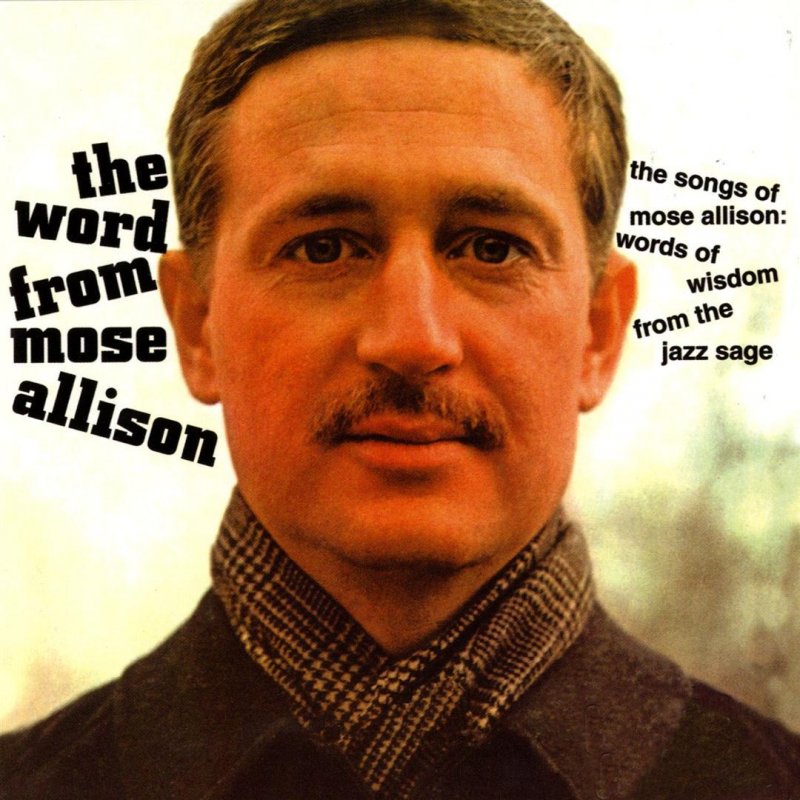
By that time, Mr. Allison’s move to Atlantic Records had begun to sharpen his reputation as a singer and songwriter. His first album for the label, “I Don’t Worry About a Thing,” released in 1962, introduced several of his best-known tunes, including the title track, a blues that deflates its own trite expression with a caustic addendum: “’Cause I know nothing’s going to be all right.” When Atlantic released “The Word From Mose” in 1964, the album cover featured a memorable tagline next to Mr. Allison’s photograph: “Words of wisdom from the jazz sage.”
Rather than make a pop or rhythm-and-blues album for the label, Mr. Allison stuck to his hybrid style, and his relatively modest commercial profile. He settled down on Long Island, where he lived for more than 40 years with his family before moving to Hilton Head Island.
In addition to his daughter Amy, Mr. Allison is survived by his wife of 65 years, Audre; two other daughters, Janine and Alissa Allison; a son, John; and two grandchildren.
While Mr. Allison released fewer albums from the mid-1970s on, he never stopped writing songs, in his dryly satirical vein. The title track of one his albums in the ’80s was “Middle Class White Boy.” A later album — released in the early 1990s, when he was 66 — opens with “Certified Senior Citizen,” followed by its incredulous pushback, “This Ain’t Me.”
For many years Mr. Allison kept up a busy touring schedule, typically with a trio. He reached some of his biggest audiences as an opening act for Van Morrison, who in 1996 made the album “Tell Me Something: The Songs of Mose Allison,” with Mr. Sidran and Mr. Fame. (Mr. Allison turned up as a guest on a couple of tracks.)
Mr. Allison’s final studio album, “The Way of the World,” was released on the British independent label Anti- in 2010. Produced by Joe Henry, who had coaxed him out of semiretirement, it finds him in an autumnal but still trenchant frame of mind, despite plaints to the contrary on the opening tune, “My Brain.” The title track, set at a saunter, has the bittersweet resignation of an old man taking stock of what he’s seen.
A live album recorded in 2006, “Mose Allison American Legend, Live in California,” was released in 2015.
In recent years Mr. Allison stopped performing but kept receiving accolades. A marker with his name and biographical details was added to the Mississippi Blues Trail in 2012. The next year he was recognized as a National Endowment for the Arts Jazz Master, the highest honor for jazz musicians.
At the induction ceremony in Manhattan, Mr. Allison accompanied his daughter Amy at the piano in a version of his ballad “Was.” A parlor waltz with connotations both mortal and memorial, it begins with some verb-tense wordplay, quickly turning poignant:
When I become was, and we become were
Will there be any sign or a trace
Of the lovely contour of your face?
And will there be someone around
With essentially my kind of sound?


Jim Eigo Jazz Promo Services T: 845-986-1677 E-Mail: jim@jazzpromoservices.com
http://www.jazzpromoservices.com

HAVE A JAZZ EVENT, NEW CD OR IMPORTANT ANNOUNCEMENT FOR THE JAZZ COMMUNITY YOU WANT TO PROMOTE? CONTACT JAZZ PROMO SERVICES FOR PRICE QUOTE.

CHECK OUT OUR NEW YOUTUBE VIDEO

Unsubscribe | Update your profile | Forward to a friend

PLEASE NOTE: IF YOU DO NOT WISH TO BE ON THIS MAILING LIST PLEASE RESPOND WITH ‘REMOVE’ IN THE SUBJECT LINE. IF YOU ARE RECEIVING DUPLICATE EMAILS OUR APOLOGIES, JAZZ PROMO SERVICES ANNOUNCEMENT LIST IS GROWING LARGER EVERY DAY…..PLEASE LET US KNOW AND WE WILL FIX IT IMMEDIATELY!

Copyright (C) 2016 All rights reserved.

Jazz Promo Services

269 State Route 94 South

Warwick, Ny 10990

Add us to your address book

slide

Mose Allison, a Font of Jazz and Blues, Dies at 89 – The New York Times

Mose Allison, a Font of Jazz and Blues, Dies at 89 – The New York Times

http://www.nytimes.com/2016/11/16/arts/music/mose-allison-a-font-of-jazz-and-blues-dies-at-89.html?emc=edit_tnt_20161115
 
Mose Allison, a Font of Jazz and Blues, Dies at 89
By NATE CHINENNOV. 15, 2016


Mose Allison in the early 1970s.
 
Michael Ochs Archives/Getty Images
Mose Allison, a pianist, singer and songwriter who straddled modern jazz and Delta blues, belonging to both styles even as he became a touchstone for British Invasion rockers and folksy troubadours, died on Tuesday at his home in Hilton Head, S.C. He was 89.
His death was confirmed by the singer and songwriter Amy Allison, his daughter.
Mr. Allison began his professional career as a piano player, at a time when his style — percussive and jaunty, carried along by a percolating beat — suited the sound of the jazz mainstream. In addition to leading his own trio, he worked with some of the major small-group bandleaders of the late 1950s, including the saxophonists Stan Getz and Gerry Mulligan.
But he found greater success, and a singular niche, as a singer of his plain-spoken, pungently observant songs, beginning in the early ’60s. For the next 50 years he worked almost exclusively as the leader of his own groups.
Mr. Allison used his cool, clear voice to conversational effect, with an easy blues inflection that harked back to his upbringing in rural Mississippi. Backing himself at the piano, he favored a loose call and response between voice and instrument, or between right and left hands, often taking tangents informed by the complex harmonies and rhythmic feints of bebop. His artistic persona, evident in his stage manner as well as his songs, suggested a distillation of folk wisdom in a knowing but unpretentious package.
close story-body close supplemental
close story-body-supplemental
He was especially revered by 1960s English rockers who idolized the blues, and who saw in his example an accessible ideal. John Mayall recorded “Parchman Farm,” Mr. Allison’s ironic adaptation of a prison blues; so did the English rhythm-and-blues singer Georgie Fame. Other songs by Mr. Allison found their way onto albums by the Yardbirds, the Kinks and the Clash. The Who based their world-beating anthem “My Generation” partly on his “Young Man Blues,” which the band also featured as the opening track on its 1970 album, “Live at Leeds.”
Mr. Allison’s tunes were covered almost as widely by his fellow Americans, including the blues artists Paul Butterfield and Johnny Winter, the country-soul singer Bobbie Gentry and, more recently, the jazz vocalist and pianist Diana Krall. The Pixies, a pace-setting alternative-rock band, named an album track “Allison” in his honor.
In a 1986 interview with the pianist Ben Sidran, conducted for NPR, Mr. Allison grouped his material into three categories: slapstick, social comment and personal crisis. “Sometimes,” he added, “all three of those elements wind up in a tune.” Many of his songs inhabit an air of wry amusement or exasperated skepticism, often pivoting on a single phrase.
He skewered hypocrisies in “Everybody’s Cryin’ Mercy,” recorded by Bonnie Raitt, and mastered the sardonic put-down in “Your Mind Is on Vacation (And Your Mouth Is Working Overtime),” covered by Elvis Costello.

 
Mr. Allison with his daughter Amy at the 2013 N.E.A. Jazz Masters Awards ceremony.
 
Joshua Bright for The New York Times
For all of his elder-statesman eminence in rock, Mr. Allison never stopped seeing himself as a jazz artist. “My definition of jazz is music that’s felt, thought and performed simultaneously,” he said in “Ever Since I Stole the Blues,” a 2006 BBC documentary. “And that’s what I’m looking for every night.”
Mose John Allison Jr. was born on Nov. 11, 1927, on a family cotton farm near Tippo, Miss. His mother taught elementary school and his father, a self-taught stride piano player, owned a general store. A service station across the road had a jukebox, on which Mr. Allison heard blues singers like Memphis Minnie and Tampa Red.
He began taking piano lessons at 5 and was playing in bands as a young teenager — around the same time he wrote his first song, “The 14-Day Palmolive Plan,” a satirical jab at radio commercials in the style of the saxophonist, singer and bandleader Louis Jordan’s jump blues. His main hero then was Nat King Cole, a well-regarded jazz pianist who had begun singing, in a smoothly urbane style, with his trio. For a while Mr. Allison also played the trumpet, on local gigs and, after he joined the Army in 1946, with the 179th Army Ground Forces Band.
Mr. Allison had put in a year at the University of Mississippi before his service, and he briefly returned to Ole Miss — one reason, perhaps, for his sobriquet “the William Faulkner of jazz,” popularized by Mr. Sidran. But he soon lost interest in his chosen field, chemical engineering. He ended up graduating from Louisiana State University with an English degree and then briefly worked the Southern club circuit.
Moving to New York City in 1956, he found work as a jazz pianist, initially with the saxophonist Al Cohn. He joined a successful quintet led by Mr. Cohn and his fellow saxophonist Zoot Sims. His style had evolved, in line with modernists like Lennie Tristano and Thelonious Monk, but he still had a trace of the South in his earthy attack, and in his untroubled relationship with blues inflection.
He recorded his debut album, “Back Country Suite,” for Prestige in 1957. A song cycle for piano trio inspired by his down-home roots, it was well reviewed but not a great commercial success. The same was true of “Local Color,” his second album, which introduced “Parchman Farm.” At the time, Mr. Allison’s unorthodox musical blend often ran up against preconceived notions of style.
“In the South, I’m considered an advanced bebop type,” he told DownBeat magazine in 1958. “In New York, I’m considered a country blues-folk type. Actually, I don’t think I’m either. Maybe I’m a little of both.”
Still, his star rose enough for him to be signed by Columbia Records, which in 1960 released “The Transfiguration of Hiram Brown,” an ambitious suite with a loosely autobiographical theme: the excitement and disillusionment of a young man who has moved from the country to the city. (Mr. Allison later returned to this subject on “If You’re Going to the City,” a signature tune.) But “Transfiguration” produced middling sales; Prestige did far better with a 1963 compilation of his vocal sides, simply titled “Mose Allison Sings.”

One of Mr. Allison’s albums from 1962.
By that time, Mr. Allison’s move to Atlantic Records had begun to sharpen his reputation as a singer and songwriter. His first album for the label, “I Don’t Worry About a Thing,” released in 1962, introduced several of his best-known tunes, including the title track, a blues that deflates its own trite expression with a caustic addendum: “’Cause I know nothing’s going to be all right.” When Atlantic released “The Word From Mose” in 1964, the album cover featured a memorable tagline next to Mr. Allison’s photograph: “Words of wisdom from the jazz sage.”
Rather than make a pop or rhythm-and-blues album for the label, Mr. Allison stuck to his hybrid style, and his relatively modest commercial profile. He settled down on Long Island, where he lived for more than 40 years with his family before moving to Hilton Head Island.
In addition to his daughter Amy, Mr. Allison is survived by his wife of 65 years, Audre; two other daughters, Janine and Alissa Allison; a son, John; and two grandchildren.
While Mr. Allison released fewer albums from the mid-1970s on, he never stopped writing songs, in his dryly satirical vein. The title track of one his albums in the ’80s was “Middle Class White Boy.” A later album — released in the early 1990s, when he was 66 — opens with “Certified Senior Citizen,” followed by its incredulous pushback, “This Ain’t Me.”
For many years Mr. Allison kept up a busy touring schedule, typically with a trio. He reached some of his biggest audiences as an opening act for Van Morrison, who in 1996 made the album “Tell Me Something: The Songs of Mose Allison,” with Mr. Sidran and Mr. Fame. (Mr. Allison turned up as a guest on a couple of tracks.)
Mr. Allison’s final studio album, “The Way of the World,” was released on the British independent label Anti- in 2010. Produced by Joe Henry, who had coaxed him out of semiretirement, it finds him in an autumnal but still trenchant frame of mind, despite plaints to the contrary on the opening tune, “My Brain.” The title track, set at a saunter, has the bittersweet resignation of an old man taking stock of what he’s seen.
A live album recorded in 2006, “Mose Allison American Legend, Live in California,” was released in 2015.
In recent years Mr. Allison stopped performing but kept receiving accolades. A marker with his name and biographical details was added to the Mississippi Blues Trail in 2012. The next year he was recognized as a National Endowment for the Arts Jazz Master, the highest honor for jazz musicians.
At the induction ceremony in Manhattan, Mr. Allison accompanied his daughter Amy at the piano in a version of his ballad “Was.” A parlor waltz with connotations both mortal and memorial, it begins with some verb-tense wordplay, quickly turning poignant:
When I become was, and we become were
Will there be any sign or a trace
Of the lovely contour of your face?
And will there be someone around
With essentially my kind of sound?


Jim Eigo Jazz Promo Services T: 845-986-1677 E-Mail: jim@jazzpromoservices.com
http://www.jazzpromoservices.com

HAVE A JAZZ EVENT, NEW CD OR IMPORTANT ANNOUNCEMENT FOR THE JAZZ COMMUNITY YOU WANT TO PROMOTE? CONTACT JAZZ PROMO SERVICES FOR PRICE QUOTE.

CHECK OUT OUR NEW YOUTUBE VIDEO

Unsubscribe | Update your profile | Forward to a friend

PLEASE NOTE: IF YOU DO NOT WISH TO BE ON THIS MAILING LIST PLEASE RESPOND WITH ‘REMOVE’ IN THE SUBJECT LINE. IF YOU ARE RECEIVING DUPLICATE EMAILS OUR APOLOGIES, JAZZ PROMO SERVICES ANNOUNCEMENT LIST IS GROWING LARGER EVERY DAY…..PLEASE LET US KNOW AND WE WILL FIX IT IMMEDIATELY!

Copyright (C) 2016 All rights reserved.

Jazz Promo Services

269 State Route 94 South

Warwick, Ny 10990

Add us to your address book

slide

RIP Mose Allison, One-of-a-Kind Jazz Pianist/Songwriter – Blogtown – Portland Mercury

RIP Mose Allison, One-of-a-Kind Jazz Pianist/Songwriter – Blogtown – Portland Mercury

http://www.portlandmercury.com/blogtown/2016/11/15/18695370/rip-mose-allison
 
RIP Mose Allison, One-of-a-Kind Jazz Pianist/Songwriter
 

It has been reported that American jazz pianist and songwriter Mose Allison died today at age 89. I’ve been a considerable fan of Allison’s one-of-a-kind music, but to be honest I didn’t even realize he was still alive. The news of his death seems like a perfect opportunity to share some of his work, a conversational brand of white beatnik jazz that both revealed his rural Mississippi roots and sounded totally urbane. This is one of my favorites:
 
 
Mose Allison – Your Molecular Structure


<div class=”player-unavailable”><h1 class=”message”>An error occurred.</h1><div class=”submessage”><a href=”http://www.youtube.com/watch?v=q9nU_85rUAw” target=”_blank”>Try watching this video on www.youtube.com</a>, or enable JavaScript if it is disabled in your browser.</div></div>
Allison is probably best known to mainstream audiences for writing “Young Man Blues,” which the Who turned into a jet-engine roar on their 1970 album Live at Leeds. Here’s a video from around that time period. It’s uncanny to me how you can still hear Allison’s unique inflection within the Who’s meaty, beaty assault.
 
 
The Who – Young Man Blues – 7/7/1970 – Tanglewood (Official)


<div class=”player-unavailable”><h1 class=”message”>An error occurred.</h1><div class=”submessage”><a href=”http://www.youtube.com/watch?v=R1CJuzpuca4″ target=”_blank”>Try watching this video on www.youtube.com</a>, or enable JavaScript if it is disabled in your browser.</div></div>
Allison was relatively unique in the jazz world in that he wrote and vocalized his songs (rather than keeping them purely instrumental, or having other singers perform them), and as such the music business had difficulty pigeonholing him, trying him out first as a pop singer and later as a blues artist. Neither really fit; Allison’s left-field songs were jazzy and cool and authentically American. Here’s a song of his that feels especially appropriate today. RIP, Mose. You were cool as hell.
 
 
Mose Allison – Everybody’s Crying Mercy


<div class=”player-unavailable”><h1 class=”message”>An error occurred.</h1><div class=”submessage”><a href=”http://www.youtube.com/watch?v=7VEzCv5cMWI” target=”_blank”>Try watching this video on www.youtube.com</a>, or enable JavaScript if it is disabled in your browser.</div></div>
I can’t believe the things I’m seeingI wonder ’bout some things I’ve heardEverybody’s crying mercyWhen they don’t know the meaning of the word
A bad enough situation, it’s sure enough getting worse
Everybody’s crying justice just as long as it’s business first
Toe to toe
Touch and go
Give a cheer
Get your souvenir
People running ’round in circles, don’t know what they’re headed for
Everybody’s crying peace on Earth just as soon as we win this war
Straight ahead
Knock ’em dead
Pack your kit
Choose your hypocrite
Well you don’t have to go to off BroadwayTo see something plain absurdEverybody’s crying mercyWhen they don’t know the meaning of the word


Jim Eigo Jazz Promo Services T: 845-986-1677 E-Mail: jim@jazzpromoservices.com
http://www.jazzpromoservices.com

HAVE A JAZZ EVENT, NEW CD OR IMPORTANT ANNOUNCEMENT FOR THE JAZZ COMMUNITY YOU WANT TO PROMOTE? CONTACT JAZZ PROMO SERVICES FOR PRICE QUOTE.

CHECK OUT OUR NEW YOUTUBE VIDEO

Unsubscribe | Update your profile | Forward to a friend

PLEASE NOTE: IF YOU DO NOT WISH TO BE ON THIS MAILING LIST PLEASE RESPOND WITH ‘REMOVE’ IN THE SUBJECT LINE. IF YOU ARE RECEIVING DUPLICATE EMAILS OUR APOLOGIES, JAZZ PROMO SERVICES ANNOUNCEMENT LIST IS GROWING LARGER EVERY DAY…..PLEASE LET US KNOW AND WE WILL FIX IT IMMEDIATELY!

Copyright (C) 2016 All rights reserved.

Jazz Promo Services

269 State Route 94 South

Warwick, Ny 10990

Add us to your address book

slide

RIP Mose Allison, One-of-a-Kind Jazz Pianist/Songwriter – Blogtown – Portland Mercury

RIP Mose Allison, One-of-a-Kind Jazz Pianist/Songwriter – Blogtown – Portland Mercury

http://www.portlandmercury.com/blogtown/2016/11/15/18695370/rip-mose-allison
 
RIP Mose Allison, One-of-a-Kind Jazz Pianist/Songwriter
 

It has been reported that American jazz pianist and songwriter Mose Allison died today at age 89. I’ve been a considerable fan of Allison’s one-of-a-kind music, but to be honest I didn’t even realize he was still alive. The news of his death seems like a perfect opportunity to share some of his work, a conversational brand of white beatnik jazz that both revealed his rural Mississippi roots and sounded totally urbane. This is one of my favorites:
 
 
Mose Allison – Your Molecular Structure


<div class=”player-unavailable”><h1 class=”message”>An error occurred.</h1><div class=”submessage”><a href=”http://www.youtube.com/watch?v=q9nU_85rUAw” target=”_blank”>Try watching this video on www.youtube.com</a>, or enable JavaScript if it is disabled in your browser.</div></div>
Allison is probably best known to mainstream audiences for writing “Young Man Blues,” which the Who turned into a jet-engine roar on their 1970 album Live at Leeds. Here’s a video from around that time period. It’s uncanny to me how you can still hear Allison’s unique inflection within the Who’s meaty, beaty assault.
 
 
The Who – Young Man Blues – 7/7/1970 – Tanglewood (Official)


<div class=”player-unavailable”><h1 class=”message”>An error occurred.</h1><div class=”submessage”><a href=”http://www.youtube.com/watch?v=R1CJuzpuca4″ target=”_blank”>Try watching this video on www.youtube.com</a>, or enable JavaScript if it is disabled in your browser.</div></div>
Allison was relatively unique in the jazz world in that he wrote and vocalized his songs (rather than keeping them purely instrumental, or having other singers perform them), and as such the music business had difficulty pigeonholing him, trying him out first as a pop singer and later as a blues artist. Neither really fit; Allison’s left-field songs were jazzy and cool and authentically American. Here’s a song of his that feels especially appropriate today. RIP, Mose. You were cool as hell.
 
 
Mose Allison – Everybody’s Crying Mercy


<div class=”player-unavailable”><h1 class=”message”>An error occurred.</h1><div class=”submessage”><a href=”http://www.youtube.com/watch?v=7VEzCv5cMWI” target=”_blank”>Try watching this video on www.youtube.com</a>, or enable JavaScript if it is disabled in your browser.</div></div>
I can’t believe the things I’m seeingI wonder ’bout some things I’ve heardEverybody’s crying mercyWhen they don’t know the meaning of the word
A bad enough situation, it’s sure enough getting worse
Everybody’s crying justice just as long as it’s business first
Toe to toe
Touch and go
Give a cheer
Get your souvenir
People running ’round in circles, don’t know what they’re headed for
Everybody’s crying peace on Earth just as soon as we win this war
Straight ahead
Knock ’em dead
Pack your kit
Choose your hypocrite
Well you don’t have to go to off BroadwayTo see something plain absurdEverybody’s crying mercyWhen they don’t know the meaning of the word


Jim Eigo Jazz Promo Services T: 845-986-1677 E-Mail: jim@jazzpromoservices.com
http://www.jazzpromoservices.com

HAVE A JAZZ EVENT, NEW CD OR IMPORTANT ANNOUNCEMENT FOR THE JAZZ COMMUNITY YOU WANT TO PROMOTE? CONTACT JAZZ PROMO SERVICES FOR PRICE QUOTE.

CHECK OUT OUR NEW YOUTUBE VIDEO

Unsubscribe | Update your profile | Forward to a friend

PLEASE NOTE: IF YOU DO NOT WISH TO BE ON THIS MAILING LIST PLEASE RESPOND WITH ‘REMOVE’ IN THE SUBJECT LINE. IF YOU ARE RECEIVING DUPLICATE EMAILS OUR APOLOGIES, JAZZ PROMO SERVICES ANNOUNCEMENT LIST IS GROWING LARGER EVERY DAY…..PLEASE LET US KNOW AND WE WILL FIX IT IMMEDIATELY!

Copyright (C) 2016 All rights reserved.

Jazz Promo Services

269 State Route 94 South

Warwick, Ny 10990

Add us to your address book

slide

Al Caiola Dead: Guitarist on Themes for ‘Bonanza,’ ‘Magnificent Seven’ Was 96 | Hollywood Reporter

Al Caiola Dead: Guitarist on Themes for ‘Bonanza,’ ‘Magnificent Seven’ Was 96 | Hollywood Reporter

http://www.hollywoodreporter.com/news/al-caiola-dead-guitarist-themes-bonanza-magnificent-seven-was-96-946769
 
Al Caiola, Guitarist on Themes for ‘Bonanza’ and ‘The Magnificent Seven,’ Dies at 96
5:38 PM PST 11/11/2016 by Mike Barnes
                 
He worked in the studio or on tour with just about everyone: Sinatra, Simon & Garfunkel, Mathis, Streisand and Darin.
 
Al Caiola, a versatile studio guitarist who recorded with Frank Sinatra, Simon & Garfunkel and dozens of other acts and had hits on his own with the theme songs from Bonanza and The Magnificent Seven, has died. He was 96.
Caiola died Wednesday in a nursing home in Allendale, N.J., his son Alexander told The Hollywood Reporter.
 
Caiola played on such hits as Paul Anka’s “Put Your Head on My Shoulder,” Neil Sedaka’s “Calendar Girl,” Bobby Darin’s “Mack the Knife” and “Splish-Splash,” Simon & Garfunkel’s “Mrs. Robinson,” Johnny Mathis’ “Chances Are,” Del Shannon’s “Runaway” and Ben E. King’s “Stand by Me.”
 
Caiola’s version of the theme song from the NBC Western Bonanza reached No. 19 on the Billboard Hot 100 list, and his take on the Magnificent Seven theme, from the 1960 film known for its Elmer Bernstein score, got as high as No. 35. Both were instrumentals released in 1961.
 
He also played on the Experiment in Terror theme written by Henry Mancini for the 1962 Blake Edwards thriller that starred Lee Remick and Glenn Ford.
 
Caiola worked with fledgling star Barbra Streisand in a Columbia Records session and also played alongside Sinatra, Elvis Presley, Tony Bennett, Buddy Holly, Sarah Vaughan, Rosemary Clooney, Petula Clark and Glen Campbell. He toured with Sinatra in 1991 and had a decades-long association with Steve Lawrence & Eydie Gorme.
 
Born in Jersey City, N.J., Caiola was the son of a barber. He enlisted in the U.S. Marines and played with Bob Crosby’s band before being pressed into active combat in the invasion at Iwo Jima. He then spent three months in Japan as part of the occupying force there.
Caiola came to New York in 1946 after the service and landed a job with the CBS orchestra. He stayed for 10 years and worked on shows hosted by Ed Sullivan, Jackie Gleason, Arthur Godfrey and Steve Allen.
 
He left his network job to free-lance and collaborated with the likes of Darin, Anka, Connie Francis, Frankie Avalon, Eddie Fisher and Perry Como and in bands fronted by Percy Faith, Morton Gould and Andre Kostelanetz.
 
Caiola was described as having a light, liquid touch. The late Moe Wechsler, a pianist who played often with him, told the Palm Beach Post in 2004 that Caiola “could play jazz, he could play classical, rock and roll, R&B. Al could do anything that was required; he’s the classic, well-rounded musician.”
 
In addition to his son, survivors include his wife of 69 years, Rosalie; daughter Sandra; grandchildren Danielle, Natalie, Heather and Alex; and great-grandchildren Sandy, Gabby, Blake and Scarlett.
 
Al Caiola @ Cutting Room 6-3-14
Frank Vignola’s Guitar Night with Al Caiola, Bucky Pizzarelli and Vinny Raniolo 

https://www.youtube.com/watch?v=nZCnCcYjrQw


Jim Eigo Jazz Promo Services T: 845-986-1677 E-Mail: jim@jazzpromoservices.com
http://www.jazzpromoservices.com

HAVE A JAZZ EVENT, NEW CD OR IMPORTANT ANNOUNCEMENT FOR THE JAZZ COMMUNITY YOU WANT TO PROMOTE? CONTACT JAZZ PROMO SERVICES FOR PRICE QUOTE.

CHECK OUT OUR NEW YOUTUBE VIDEO

Unsubscribe | Update your profile | Forward to a friend

PLEASE NOTE: IF YOU DO NOT WISH TO BE ON THIS MAILING LIST PLEASE RESPOND WITH ‘REMOVE’ IN THE SUBJECT LINE. IF YOU ARE RECEIVING DUPLICATE EMAILS OUR APOLOGIES, JAZZ PROMO SERVICES ANNOUNCEMENT LIST IS GROWING LARGER EVERY DAY…..PLEASE LET US KNOW AND WE WILL FIX IT IMMEDIATELY!

Copyright (C) 2016 All rights reserved.

Jazz Promo Services

269 State Route 94 South

Warwick, Ny 10990

Add us to your address book

slide

Al Caiola Dead: Guitarist on Themes for ‘Bonanza,’ ‘Magnificent Seven’ Was 96 | Hollywood Reporter

Al Caiola Dead: Guitarist on Themes for ‘Bonanza,’ ‘Magnificent Seven’ Was 96 | Hollywood Reporter

http://www.hollywoodreporter.com/news/al-caiola-dead-guitarist-themes-bonanza-magnificent-seven-was-96-946769
 
Al Caiola, Guitarist on Themes for ‘Bonanza’ and ‘The Magnificent Seven,’ Dies at 96
5:38 PM PST 11/11/2016 by Mike Barnes
                 
He worked in the studio or on tour with just about everyone: Sinatra, Simon & Garfunkel, Mathis, Streisand and Darin.
 
Al Caiola, a versatile studio guitarist who recorded with Frank Sinatra, Simon & Garfunkel and dozens of other acts and had hits on his own with the theme songs from Bonanza and The Magnificent Seven, has died. He was 96.
Caiola died Wednesday in a nursing home in Allendale, N.J., his son Alexander told The Hollywood Reporter.
 
Caiola played on such hits as Paul Anka’s “Put Your Head on My Shoulder,” Neil Sedaka’s “Calendar Girl,” Bobby Darin’s “Mack the Knife” and “Splish-Splash,” Simon & Garfunkel’s “Mrs. Robinson,” Johnny Mathis’ “Chances Are,” Del Shannon’s “Runaway” and Ben E. King’s “Stand by Me.”
 
Caiola’s version of the theme song from the NBC Western Bonanza reached No. 19 on the Billboard Hot 100 list, and his take on the Magnificent Seven theme, from the 1960 film known for its Elmer Bernstein score, got as high as No. 35. Both were instrumentals released in 1961.
 
He also played on the Experiment in Terror theme written by Henry Mancini for the 1962 Blake Edwards thriller that starred Lee Remick and Glenn Ford.
 
Caiola worked with fledgling star Barbra Streisand in a Columbia Records session and also played alongside Sinatra, Elvis Presley, Tony Bennett, Buddy Holly, Sarah Vaughan, Rosemary Clooney, Petula Clark and Glen Campbell. He toured with Sinatra in 1991 and had a decades-long association with Steve Lawrence & Eydie Gorme.
 
Born in Jersey City, N.J., Caiola was the son of a barber. He enlisted in the U.S. Marines and played with Bob Crosby’s band before being pressed into active combat in the invasion at Iwo Jima. He then spent three months in Japan as part of the occupying force there.
Caiola came to New York in 1946 after the service and landed a job with the CBS orchestra. He stayed for 10 years and worked on shows hosted by Ed Sullivan, Jackie Gleason, Arthur Godfrey and Steve Allen.
 
He left his network job to free-lance and collaborated with the likes of Darin, Anka, Connie Francis, Frankie Avalon, Eddie Fisher and Perry Como and in bands fronted by Percy Faith, Morton Gould and Andre Kostelanetz.
 
Caiola was described as having a light, liquid touch. The late Moe Wechsler, a pianist who played often with him, told the Palm Beach Post in 2004 that Caiola “could play jazz, he could play classical, rock and roll, R&B. Al could do anything that was required; he’s the classic, well-rounded musician.”
 
In addition to his son, survivors include his wife of 69 years, Rosalie; daughter Sandra; grandchildren Danielle, Natalie, Heather and Alex; and great-grandchildren Sandy, Gabby, Blake and Scarlett.
 
Al Caiola @ Cutting Room 6-3-14
Frank Vignola’s Guitar Night with Al Caiola, Bucky Pizzarelli and Vinny Raniolo 

https://www.youtube.com/watch?v=nZCnCcYjrQw


Jim Eigo Jazz Promo Services T: 845-986-1677 E-Mail: jim@jazzpromoservices.com
http://www.jazzpromoservices.com

HAVE A JAZZ EVENT, NEW CD OR IMPORTANT ANNOUNCEMENT FOR THE JAZZ COMMUNITY YOU WANT TO PROMOTE? CONTACT JAZZ PROMO SERVICES FOR PRICE QUOTE.

CHECK OUT OUR NEW YOUTUBE VIDEO

Unsubscribe | Update your profile | Forward to a friend

PLEASE NOTE: IF YOU DO NOT WISH TO BE ON THIS MAILING LIST PLEASE RESPOND WITH ‘REMOVE’ IN THE SUBJECT LINE. IF YOU ARE RECEIVING DUPLICATE EMAILS OUR APOLOGIES, JAZZ PROMO SERVICES ANNOUNCEMENT LIST IS GROWING LARGER EVERY DAY…..PLEASE LET US KNOW AND WE WILL FIX IT IMMEDIATELY!

Copyright (C) 2016 All rights reserved.

Jazz Promo Services

269 State Route 94 South

Warwick, Ny 10990

Add us to your address book

slide

How Newark became one of the greatest jazz cities in the world | Music | The Guardian

How Newark became one of the greatest jazz cities in the world | Music | The Guardian


https://www.theguardian.com/music/2016/nov/11/newark-new-jersey-jazz-institute-njpac-clements-place?mc_cid=f054b4697b
 
How Newark became one of the greatest jazz cities in the world
History has defined the New Jersey city as a hub for a host of jazz musicians from Sarah Vaughan to Christian McBride, and it remains a vibrant destination for fans of the genre
Tammy La Gorce

[if IE 9]></video><![endif]
Dianne Reeves with Christian McBride. Photograph: New Jersey Performing Arts Center
A year before he died in 1977, the blind jazz genius Rahsaan Roland Kirk inspired an impromptu parade in Newark, New Jersey. One minute he was playing the downtown club Sparky J’s. The next he was leading his band, pied-piper-like, across the street to the Key Club, a different nightspot, while still making music on one of the three saxes he was known to play in unison and in harmony.
“It was legendary,” said Junius Williams, a Newark author and educator who also saw Dizzy Gillespie at Sparky J’s back in the day.
It was also kind of prescient. In 2016, Newark is one nonstop, ongoing, jazz parade: Wynton Marsalis, the Robert Glasper Experiment, Dianne Reeves, Phil Perry, David Sanborn and Anjelique Kidjo have been in and out town for shows. Dorthaan Kirk, the widow of Rahsaan who goes by the nickname “Newark’s first lady of jazz”, has hosted longtime greats including Freddy Cole, Jon Faddis and Rufus Reid at a pair of local series she organizes (both of them running through 2017, one of them free). And by the end of the year, a new, intimate club called Clement’s Place connected to the city’s renowned Institute of Jazz Studies at Rutgers-Newark will have attracted the TS Monk Sextet and the soul-threaded and Eubie Blake Award-winning Houston Person Quartet.
Behind all the action is a celebration of the city’s birthday – 2016 marks Newark’s 350th year – that, together with the TD James Moody jazz festival, an annual celebration of jazz running through the end of November, has revived its reputation as a serious jazz town.
The Grammy-winning bassist and bandleader Christian McBride, who is performing at Moody Fest on 18 November alongside Sharon Jones, Bettye LaVette and the James Brown Alumni Band at the city’s most thriving jazz venue, the New Jersey Performing Arts Center, saw it coming.
“Newark’s place in jazz history includes Sarah Vaughan, Wayne Shorter, James Moody, Woody Shaw and Larry Young, among others. That coupled with its modern-day vibrancy makes Newark one of the greatest jazz cities in the world,” McBride said in early November from Europe, where he was touring.
He is especially qualified to say so. McBride first played in Newark as a young performer 26 years ago and, since 2012, has been NJPAC’s jazz adviser; he also hosts the NPR show Jazz Night in America, a co-production with Lincoln Center and WBGO-FM, the only full-time jazz format station broadcast in New York and New Jersey. On 20 November he will be among the judges of what John Schreiber, founder of the Moody festival and NJPAC’s president and CEO, called one of the centerpieces of a monthlong event: the Sarah Vaughan International Jazz Competition.
“Jazz singing is bred in the bone. And Sarah Vaughan and Ella Fitzgerald were kind of No 1 and No 2 in terms of the great individual voices of jazz singing,” Schreiber said. “Sarah Vaughan was an authentic Newark girl – she went to high school here and lived a lot of her life here. And so I said, ‘OK, what can we do to honor Sarah?’”
That was five years ago, when Schreiber signed on with NJPAC after decades of producing and curating festivals including Newport Jazz and JVC Jazz.
[if IE 9]><video style=”display: none;”><![endif]

[if IE 9]></video><![endif]
Sharon Jones will play the TD James Moody jazz festival in Newark later in November. Photograph: New Jersey Performing Arts Center
The result is the upcoming competition in which five finalists, whittled from a pool of hundreds around the world who sent online auditions to Newark this spring, perform before McBride and four fellow jazz-luminary judges – Dianne Reeves among them – plus a packed NJPAC house.
The winner is announced at the end of the night and walks away with a recording contract, a $5,000 prize and a slot to perform at the Montreal Jazz Fest next summer.
“She also has a right to say she won the Sarah Vaughan International Jazz Competition. And then all of a sudden she has some stature with the public,” Schreiber said.
Jazz stature comes in a couple of shapes around Newark. There is the kind earned through sheer chops, like winning the vocal competition or commanding a massive audience during one of the organ jams held sporadically at Symphony Hall, a historic jazz venue not far from NJPAC. There is the kind Dorthaan Kirk has acquired through knowing everyone from Jimmy Heath to Gregory Porter and attracting them to town for her jazz series. (One is Dorthaan’s Place, a jazz brunch at NJPAC; the other is Jazz Vespers at Bethany Baptist church. Both are monthly, Bethany is free.)
There is also a kind of stature bestowed through scholarship. The night before the Sarah Vaughan competition, for example, McBride’s Trio will play The Divine One, a concert at NJPAC honoring Vaughan that includes a film about her life and a panel discussion hosted by the longtime jazz producer Todd Barkan, also artistic director at Jazz at Lincoln Center’s Dizzy’s Club Coca-Cola.
Like a lot of the smartest jazz events around town, it’s being sponsored by the Institute of Jazz Studies at Rutgers-Newark.
The jazz institute, founded in 1952, is the most extensive jazz archive and library in the US. It includes more than 150,000 recordings and 6,000 books, and treasures such as Miles Davis’s trumpet and Curly Russell’s bass. Before Ken Burns made his 10-part, Emmy-nominated mini-series Jazz in 2000, he spent a year exploring the institute’s trove of recordings. Forest Whitaker visited the archives in 2011 for research on a film about Louis Armstrong, And Michael K Smith spent some time browsing there after his role as Chalky White on HBO’s Boardwalk Empire got him interested 20s- and 30s-era jazz.
[if IE 9]><video style=”display: none;”><![endif]

[if IE 9]></video><![endif]
Carrie Jackson performing at Clement’s Place. Photograph: Ed Berger
Earlier this year, the Jazz Institute entered the club business with Clement’s Place, a 75-seat venue done up in jazz memorabilia on the ground floor of a historical neoclassical Newark skyscraper. Minus the whiffs of cigar smoke and seal-fresh whiskey (Clement’s pours beer and wine only), it’s a throwback to the tight-knit jazz communities documented in the archives.
“I didn’t expect it, but I love running the bar,” said Wayne Winbourne, the institute’s executive director. Clement’s is named for Dr Clement A Price, a beloved Rutgers-Newark professor and devoted jazz fan who died suddenly in 2014. “We’re open to the community, so we’re seeing a cross-section of folks from Newark who are bringing real energy and dynamism.”
They’re bringing it to monthly jam sessions organized in cooperation with NJPAC as part of the 350th birthday celebration, and they’re bringing it to more subdued events such as a series of curated listening sessions Winbourne says he is “sprinkling in” at Clement’s once or twice a month, between shows and jams. There’s already been listening sessions on very early Louis Armstrong and Harry “Sweets” Edison.
“We’ve got incredible experts on staff who are just extremely knowledgeable,” said Winbourne. “Sometimes we get 10 people, sometimes we get 30. But we’ll have a drink, then we’ll play a cut. Then we’ll have another drink, and play another cut. It’s another way for us to bring the archives to the public, to draw upon the expertise of our staff and to engage the community. We’re tapping into an opportunity there.”
There’s also an opportunity, because of the institute’s reputation “and because I know folks”, said Winbourne, to draw artists who might otherwise skip Newark when playing across the river in New York.
“We have the Lance Bryant Quartet coming in later this year – he played with Lionel Hampton – and a concert coming up with the flutist Elise Wood. And I’m hoping to get Steve Wilson and Luis Bonilla in here,” said Winbourne.
He may not have to try too hard: “There’s a jazz atmosphere now that’s so intimate, where we all feel so connected,” Winbourne said. “I think all of us here in Newark are looking at the rise of something special, something people are going to be talking about a long time.”


Jim Eigo Jazz Promo Services T: 845-986-1677 E-Mail: jim@jazzpromoservices.com
http://www.jazzpromoservices.com

HAVE A JAZZ EVENT, NEW CD OR IMPORTANT ANNOUNCEMENT FOR THE JAZZ COMMUNITY YOU WANT TO PROMOTE? CONTACT JAZZ PROMO SERVICES FOR PRICE QUOTE.

CHECK OUT OUR NEW YOUTUBE VIDEO

Unsubscribe | Update your profile | Forward to a friend

PLEASE NOTE: IF YOU DO NOT WISH TO BE ON THIS MAILING LIST PLEASE RESPOND WITH ‘REMOVE’ IN THE SUBJECT LINE. IF YOU ARE RECEIVING DUPLICATE EMAILS OUR APOLOGIES, JAZZ PROMO SERVICES ANNOUNCEMENT LIST IS GROWING LARGER EVERY DAY…..PLEASE LET US KNOW AND WE WILL FIX IT IMMEDIATELY!

Copyright (C) 2016 All rights reserved.

Jazz Promo Services

269 State Route 94 South

Warwick, Ny 10990

Add us to your address book

slide

How Newark became one of the greatest jazz cities in the world | Music | The Guardian

How Newark became one of the greatest jazz cities in the world | Music | The Guardian


https://www.theguardian.com/music/2016/nov/11/newark-new-jersey-jazz-institute-njpac-clements-place?mc_cid=f054b4697b
 
How Newark became one of the greatest jazz cities in the world
History has defined the New Jersey city as a hub for a host of jazz musicians from Sarah Vaughan to Christian McBride, and it remains a vibrant destination for fans of the genre
Tammy La Gorce

[if IE 9]></video><![endif]
Dianne Reeves with Christian McBride. Photograph: New Jersey Performing Arts Center
A year before he died in 1977, the blind jazz genius Rahsaan Roland Kirk inspired an impromptu parade in Newark, New Jersey. One minute he was playing the downtown club Sparky J’s. The next he was leading his band, pied-piper-like, across the street to the Key Club, a different nightspot, while still making music on one of the three saxes he was known to play in unison and in harmony.
“It was legendary,” said Junius Williams, a Newark author and educator who also saw Dizzy Gillespie at Sparky J’s back in the day.
It was also kind of prescient. In 2016, Newark is one nonstop, ongoing, jazz parade: Wynton Marsalis, the Robert Glasper Experiment, Dianne Reeves, Phil Perry, David Sanborn and Anjelique Kidjo have been in and out town for shows. Dorthaan Kirk, the widow of Rahsaan who goes by the nickname “Newark’s first lady of jazz”, has hosted longtime greats including Freddy Cole, Jon Faddis and Rufus Reid at a pair of local series she organizes (both of them running through 2017, one of them free). And by the end of the year, a new, intimate club called Clement’s Place connected to the city’s renowned Institute of Jazz Studies at Rutgers-Newark will have attracted the TS Monk Sextet and the soul-threaded and Eubie Blake Award-winning Houston Person Quartet.
Behind all the action is a celebration of the city’s birthday – 2016 marks Newark’s 350th year – that, together with the TD James Moody jazz festival, an annual celebration of jazz running through the end of November, has revived its reputation as a serious jazz town.
The Grammy-winning bassist and bandleader Christian McBride, who is performing at Moody Fest on 18 November alongside Sharon Jones, Bettye LaVette and the James Brown Alumni Band at the city’s most thriving jazz venue, the New Jersey Performing Arts Center, saw it coming.
“Newark’s place in jazz history includes Sarah Vaughan, Wayne Shorter, James Moody, Woody Shaw and Larry Young, among others. That coupled with its modern-day vibrancy makes Newark one of the greatest jazz cities in the world,” McBride said in early November from Europe, where he was touring.
He is especially qualified to say so. McBride first played in Newark as a young performer 26 years ago and, since 2012, has been NJPAC’s jazz adviser; he also hosts the NPR show Jazz Night in America, a co-production with Lincoln Center and WBGO-FM, the only full-time jazz format station broadcast in New York and New Jersey. On 20 November he will be among the judges of what John Schreiber, founder of the Moody festival and NJPAC’s president and CEO, called one of the centerpieces of a monthlong event: the Sarah Vaughan International Jazz Competition.
“Jazz singing is bred in the bone. And Sarah Vaughan and Ella Fitzgerald were kind of No 1 and No 2 in terms of the great individual voices of jazz singing,” Schreiber said. “Sarah Vaughan was an authentic Newark girl – she went to high school here and lived a lot of her life here. And so I said, ‘OK, what can we do to honor Sarah?’”
That was five years ago, when Schreiber signed on with NJPAC after decades of producing and curating festivals including Newport Jazz and JVC Jazz.
[if IE 9]><video style=”display: none;”><![endif]

[if IE 9]></video><![endif]
Sharon Jones will play the TD James Moody jazz festival in Newark later in November. Photograph: New Jersey Performing Arts Center
The result is the upcoming competition in which five finalists, whittled from a pool of hundreds around the world who sent online auditions to Newark this spring, perform before McBride and four fellow jazz-luminary judges – Dianne Reeves among them – plus a packed NJPAC house.
The winner is announced at the end of the night and walks away with a recording contract, a $5,000 prize and a slot to perform at the Montreal Jazz Fest next summer.
“She also has a right to say she won the Sarah Vaughan International Jazz Competition. And then all of a sudden she has some stature with the public,” Schreiber said.
Jazz stature comes in a couple of shapes around Newark. There is the kind earned through sheer chops, like winning the vocal competition or commanding a massive audience during one of the organ jams held sporadically at Symphony Hall, a historic jazz venue not far from NJPAC. There is the kind Dorthaan Kirk has acquired through knowing everyone from Jimmy Heath to Gregory Porter and attracting them to town for her jazz series. (One is Dorthaan’s Place, a jazz brunch at NJPAC; the other is Jazz Vespers at Bethany Baptist church. Both are monthly, Bethany is free.)
There is also a kind of stature bestowed through scholarship. The night before the Sarah Vaughan competition, for example, McBride’s Trio will play The Divine One, a concert at NJPAC honoring Vaughan that includes a film about her life and a panel discussion hosted by the longtime jazz producer Todd Barkan, also artistic director at Jazz at Lincoln Center’s Dizzy’s Club Coca-Cola.
Like a lot of the smartest jazz events around town, it’s being sponsored by the Institute of Jazz Studies at Rutgers-Newark.
The jazz institute, founded in 1952, is the most extensive jazz archive and library in the US. It includes more than 150,000 recordings and 6,000 books, and treasures such as Miles Davis’s trumpet and Curly Russell’s bass. Before Ken Burns made his 10-part, Emmy-nominated mini-series Jazz in 2000, he spent a year exploring the institute’s trove of recordings. Forest Whitaker visited the archives in 2011 for research on a film about Louis Armstrong, And Michael K Smith spent some time browsing there after his role as Chalky White on HBO’s Boardwalk Empire got him interested 20s- and 30s-era jazz.
[if IE 9]><video style=”display: none;”><![endif]

[if IE 9]></video><![endif]
Carrie Jackson performing at Clement’s Place. Photograph: Ed Berger
Earlier this year, the Jazz Institute entered the club business with Clement’s Place, a 75-seat venue done up in jazz memorabilia on the ground floor of a historical neoclassical Newark skyscraper. Minus the whiffs of cigar smoke and seal-fresh whiskey (Clement’s pours beer and wine only), it’s a throwback to the tight-knit jazz communities documented in the archives.
“I didn’t expect it, but I love running the bar,” said Wayne Winbourne, the institute’s executive director. Clement’s is named for Dr Clement A Price, a beloved Rutgers-Newark professor and devoted jazz fan who died suddenly in 2014. “We’re open to the community, so we’re seeing a cross-section of folks from Newark who are bringing real energy and dynamism.”
They’re bringing it to monthly jam sessions organized in cooperation with NJPAC as part of the 350th birthday celebration, and they’re bringing it to more subdued events such as a series of curated listening sessions Winbourne says he is “sprinkling in” at Clement’s once or twice a month, between shows and jams. There’s already been listening sessions on very early Louis Armstrong and Harry “Sweets” Edison.
“We’ve got incredible experts on staff who are just extremely knowledgeable,” said Winbourne. “Sometimes we get 10 people, sometimes we get 30. But we’ll have a drink, then we’ll play a cut. Then we’ll have another drink, and play another cut. It’s another way for us to bring the archives to the public, to draw upon the expertise of our staff and to engage the community. We’re tapping into an opportunity there.”
There’s also an opportunity, because of the institute’s reputation “and because I know folks”, said Winbourne, to draw artists who might otherwise skip Newark when playing across the river in New York.
“We have the Lance Bryant Quartet coming in later this year – he played with Lionel Hampton – and a concert coming up with the flutist Elise Wood. And I’m hoping to get Steve Wilson and Luis Bonilla in here,” said Winbourne.
He may not have to try too hard: “There’s a jazz atmosphere now that’s so intimate, where we all feel so connected,” Winbourne said. “I think all of us here in Newark are looking at the rise of something special, something people are going to be talking about a long time.”


Jim Eigo Jazz Promo Services T: 845-986-1677 E-Mail: jim@jazzpromoservices.com
http://www.jazzpromoservices.com

HAVE A JAZZ EVENT, NEW CD OR IMPORTANT ANNOUNCEMENT FOR THE JAZZ COMMUNITY YOU WANT TO PROMOTE? CONTACT JAZZ PROMO SERVICES FOR PRICE QUOTE.

CHECK OUT OUR NEW YOUTUBE VIDEO

Unsubscribe | Update your profile | Forward to a friend

PLEASE NOTE: IF YOU DO NOT WISH TO BE ON THIS MAILING LIST PLEASE RESPOND WITH ‘REMOVE’ IN THE SUBJECT LINE. IF YOU ARE RECEIVING DUPLICATE EMAILS OUR APOLOGIES, JAZZ PROMO SERVICES ANNOUNCEMENT LIST IS GROWING LARGER EVERY DAY…..PLEASE LET US KNOW AND WE WILL FIX IT IMMEDIATELY!

Copyright (C) 2016 All rights reserved.

Jazz Promo Services

269 State Route 94 South

Warwick, Ny 10990

Add us to your address book

slide

Slim Gaillard’s Civilisation 4-part documentary directed by Anthony Wall. – YouTube

Slim Gaillard’s Civilisation 4-part documentary directed by Anthony Wall. – YouTube

https://www.youtube.com/playlist?list=PL-pyaHg7-c60HUfpZSkOCLasRjnnCrI7K

https://www.loc.gov/item/jots.200019337
SLIM GAILLARD’S CIVILISATION
About this Item
SLIM GAILLARD’S CIVILISATION
Contributor Names
Anthony Wall (director)
Created / Published
UK.
Notes
–  Information from: “Jazz on the Screen” by David Meeker. Used with permission. (Source)
–  Made-for-TV series.
–  Short film (under 30 minutes).
–  Slim Gaillard profiled, with the help of film clips, Dizzy Gillespie, Frankie Laine, Max Gordon, Tito Puente and others. (Personnel on Camera)
–  Jazz on the Screen is a reference work of filmographic information and does not point to digitized versions of the items described. The Library of Congress may or may not own a copy of a particular film or video. To request additional information Ask a Librarian (http://www.loc.gov/rr/askalib/ask-record.html). 


Jim Eigo Jazz Promo Services T: 845-986-1677 E-Mail: jim@jazzpromoservices.com
http://www.jazzpromoservices.com

HAVE A JAZZ EVENT, NEW CD OR IMPORTANT ANNOUNCEMENT FOR THE JAZZ COMMUNITY YOU WANT TO PROMOTE? CONTACT JAZZ PROMO SERVICES FOR PRICE QUOTE.

CHECK OUT OUR NEW YOUTUBE VIDEO

Unsubscribe | Update your profile | Forward to a friend

PLEASE NOTE: IF YOU DO NOT WISH TO BE ON THIS MAILING LIST PLEASE RESPOND WITH ‘REMOVE’ IN THE SUBJECT LINE. IF YOU ARE RECEIVING DUPLICATE EMAILS OUR APOLOGIES, JAZZ PROMO SERVICES ANNOUNCEMENT LIST IS GROWING LARGER EVERY DAY…..PLEASE LET US KNOW AND WE WILL FIX IT IMMEDIATELY!

Copyright (C) 2016 All rights reserved.

Jazz Promo Services

269 State Route 94 South

Warwick, Ny 10990

Add us to your address book

slide

Slim Gaillard’s Civilisation 4-part documentary directed by Anthony Wall. – YouTube

Slim Gaillard’s Civilisation 4-part documentary directed by Anthony Wall. – YouTube

https://www.youtube.com/playlist?list=PL-pyaHg7-c60HUfpZSkOCLasRjnnCrI7K

https://www.loc.gov/item/jots.200019337
SLIM GAILLARD’S CIVILISATION
About this Item
SLIM GAILLARD’S CIVILISATION
Contributor Names
Anthony Wall (director)
Created / Published
UK.
Notes
–  Information from: “Jazz on the Screen” by David Meeker. Used with permission. (Source)
–  Made-for-TV series.
–  Short film (under 30 minutes).
–  Slim Gaillard profiled, with the help of film clips, Dizzy Gillespie, Frankie Laine, Max Gordon, Tito Puente and others. (Personnel on Camera)
–  Jazz on the Screen is a reference work of filmographic information and does not point to digitized versions of the items described. The Library of Congress may or may not own a copy of a particular film or video. To request additional information Ask a Librarian (http://www.loc.gov/rr/askalib/ask-record.html). 


Jim Eigo Jazz Promo Services T: 845-986-1677 E-Mail: jim@jazzpromoservices.com
http://www.jazzpromoservices.com

HAVE A JAZZ EVENT, NEW CD OR IMPORTANT ANNOUNCEMENT FOR THE JAZZ COMMUNITY YOU WANT TO PROMOTE? CONTACT JAZZ PROMO SERVICES FOR PRICE QUOTE.

CHECK OUT OUR NEW YOUTUBE VIDEO

Unsubscribe | Update your profile | Forward to a friend

PLEASE NOTE: IF YOU DO NOT WISH TO BE ON THIS MAILING LIST PLEASE RESPOND WITH ‘REMOVE’ IN THE SUBJECT LINE. IF YOU ARE RECEIVING DUPLICATE EMAILS OUR APOLOGIES, JAZZ PROMO SERVICES ANNOUNCEMENT LIST IS GROWING LARGER EVERY DAY…..PLEASE LET US KNOW AND WE WILL FIX IT IMMEDIATELY!

Copyright (C) 2016 All rights reserved.

Jazz Promo Services

269 State Route 94 South

Warwick, Ny 10990

Add us to your address book

slide

In Memoriam: Victor Bailey

In Memoriam: Victor Bailey


http://www.reuters.com/article/us-people-leonrussell-idUSKBN1380JM
 
ENTERTAINMENT NEWS | Sun Nov 13, 2016 | 10:28am EST
 
Leon Russell, musician known for dynamic performances, dies at 74
 
Musician Leon Russell poses for a portrait in New York June 15, 2011. REUTERS/Lucas Jackson


By Bill Trott
 
Leon Russell, who emerged in the ’70s as one of rock’n’roll’s most dynamic performers and songwriters after playing anonymously on dozens of pop hits as a much-in-demand studio pianist in the 1960s, died on Sunday at the age of 74, according to his website.
Russell, who was inducted into the Rock and Roll Hall of Fame in 2011, died in his sleep in Nashville, Tennessee, his wife said in a statement on the website.
Russell had endured health problems in his later years, undergoing surgery to stop leaking brain fluid in 2010 and suffering a heart attack in July 2016.
Russell’s period of stardom as a performer was relatively brief but Elton John, who had once been Russell’s opening act, engineered a comeback for him in 2010 when they collaborated on an album titled “The Union.”
 
“He was my biggest influence as a piano player, a singer and a songwriter,” John told ABC News.
Russell recorded more than 35 albums and also excelled as a songwriter for other performers. His “A Song for You” was recorded by Joe Cocker, the Carpenters, the Temptations, Neil Diamond, Lou Rawls, Dusty Springfield, Ray Charles, Aretha Franklin and his good friend Willie Nelson. The Carpenters, Reddy, Shirley Bassey, Robert Goulet and George Benson all covered Russell’s “This Masquerade,” with Benson’s version winning the 1976 Grammy as record of the year.
Russell was known as “the master of space and time” in his ’70s heyday. He wore a cocked top hat and, with salt-and-pepper hair past his shoulders and a beard that reached his chest, created an inscrutable image that was equal parts shaman, tent revival preacher and cosmic ringmaster.
He ruled the stage with piano-banging abandon and, backed by a multi-piece band and a backup chorus, put on a show that was a roiling stew of rock, soul, gospel and country.
 
WRECKING CREW
He was born Claude Russell Bridges on April 2, 1942, and grew up in the Tulsa, Oklahoma, area. He was playing in bars at age 14 and joined a band that included J.J. Cale, who also would go on to music stardom.
Russell moved to Los Angeles as American music was taking a new shape. He became part of a talented pool of studio musicians known informally as the Wrecking Crew who provided back up for pop and rock hits of the early and mid-1960s, including those by Jan and Dean, the Beach Boys, the Monkees and the Byrds. Russell also was part of producer Phil Spector’s trademark “Wall of Sound” recording team.
Russell also played guitar, worked as an arranger, songwriter and piano player for the house band on the popular television dance show “Shindig.”
He eased into the spotlight in 1970 as a driving force on Joe Cocker’s landmark Mad Dogs and Englishmen tour. Russell assembled the 20-piece band, which came with a legion of hangers-on, and served as its leader on a riotous two-month U.S. tour that spawned a double-disc live album and a documentary film.
His work with Cocker, an appearance in the film about George Harrison’s 1971 “Concert for Bangladesh” and his first solo album, which featured contributions from three Rolling Stones and two Beatles, made Russell a star in his own right in 1970.
In 1969 Russell and Denny Cordell started Shelter Records, which put out recordings by Russell, Cale, Freddie King, Tom Petty and the Heartbreakers and Phoebe Snow.
 
After his rock stardom faded, Russell adopted the alter ego of Hank Wilson for several albums of country classics that let him turn loose his Oklahoma twang.
Although he continued recording and touring, Russell was far from the spotlight in the 1990s and 2000s until he and John recorded “The Union” and went on a short joint tour. John said he was inspired to collaborate when he was moved to tears upon rehearing Russell’s song “Back to the Island.”
Russell, who had to have surgery because of leaking brain fluid a week before going into the studio, said it was the first time he had heard from John in 35 years.
“If Leon can get the accolades he deserves and be financially OK for the rest of his life, I will have done something decent with my music,” John told the New York Times.
The Russell-written song “If It Wasn’t for Bad” off “The Union” received a Grammy nomination.
 
(Reporting by Bill Trott; Additional reporting by David Ingram; Editing by James Dalgleish)


Jim Eigo Jazz Promo Services T: 845-986-1677 E-Mail: jim@jazzpromoservices.com
http://www.jazzpromoservices.com

HAVE A JAZZ EVENT, NEW CD OR IMPORTANT ANNOUNCEMENT FOR THE JAZZ COMMUNITY YOU WANT TO PROMOTE? CONTACT JAZZ PROMO SERVICES FOR PRICE QUOTE.

CHECK OUT OUR NEW YOUTUBE VIDEO

Unsubscribe | Update your profile | Forward to a friend

PLEASE NOTE: IF YOU DO NOT WISH TO BE ON THIS MAILING LIST PLEASE RESPOND WITH ‘REMOVE’ IN THE SUBJECT LINE. IF YOU ARE RECEIVING DUPLICATE EMAILS OUR APOLOGIES, JAZZ PROMO SERVICES ANNOUNCEMENT LIST IS GROWING LARGER EVERY DAY…..PLEASE LET US KNOW AND WE WILL FIX IT IMMEDIATELY!

Copyright (C) 2016 All rights reserved.

Jazz Promo Services

269 State Route 94 South

Warwick, Ny 10990

Add us to your address book

slide

In Memoriam: Victor Bailey

In Memoriam: Victor Bailey


http://www.reuters.com/article/us-people-leonrussell-idUSKBN1380JM
 
ENTERTAINMENT NEWS | Sun Nov 13, 2016 | 10:28am EST
 
Leon Russell, musician known for dynamic performances, dies at 74
 
Musician Leon Russell poses for a portrait in New York June 15, 2011. REUTERS/Lucas Jackson


By Bill Trott
 
Leon Russell, who emerged in the ’70s as one of rock’n’roll’s most dynamic performers and songwriters after playing anonymously on dozens of pop hits as a much-in-demand studio pianist in the 1960s, died on Sunday at the age of 74, according to his website.
Russell, who was inducted into the Rock and Roll Hall of Fame in 2011, died in his sleep in Nashville, Tennessee, his wife said in a statement on the website.
Russell had endured health problems in his later years, undergoing surgery to stop leaking brain fluid in 2010 and suffering a heart attack in July 2016.
Russell’s period of stardom as a performer was relatively brief but Elton John, who had once been Russell’s opening act, engineered a comeback for him in 2010 when they collaborated on an album titled “The Union.”
 
“He was my biggest influence as a piano player, a singer and a songwriter,” John told ABC News.
Russell recorded more than 35 albums and also excelled as a songwriter for other performers. His “A Song for You” was recorded by Joe Cocker, the Carpenters, the Temptations, Neil Diamond, Lou Rawls, Dusty Springfield, Ray Charles, Aretha Franklin and his good friend Willie Nelson. The Carpenters, Reddy, Shirley Bassey, Robert Goulet and George Benson all covered Russell’s “This Masquerade,” with Benson’s version winning the 1976 Grammy as record of the year.
Russell was known as “the master of space and time” in his ’70s heyday. He wore a cocked top hat and, with salt-and-pepper hair past his shoulders and a beard that reached his chest, created an inscrutable image that was equal parts shaman, tent revival preacher and cosmic ringmaster.
He ruled the stage with piano-banging abandon and, backed by a multi-piece band and a backup chorus, put on a show that was a roiling stew of rock, soul, gospel and country.
 
WRECKING CREW
He was born Claude Russell Bridges on April 2, 1942, and grew up in the Tulsa, Oklahoma, area. He was playing in bars at age 14 and joined a band that included J.J. Cale, who also would go on to music stardom.
Russell moved to Los Angeles as American music was taking a new shape. He became part of a talented pool of studio musicians known informally as the Wrecking Crew who provided back up for pop and rock hits of the early and mid-1960s, including those by Jan and Dean, the Beach Boys, the Monkees and the Byrds. Russell also was part of producer Phil Spector’s trademark “Wall of Sound” recording team.
Russell also played guitar, worked as an arranger, songwriter and piano player for the house band on the popular television dance show “Shindig.”
He eased into the spotlight in 1970 as a driving force on Joe Cocker’s landmark Mad Dogs and Englishmen tour. Russell assembled the 20-piece band, which came with a legion of hangers-on, and served as its leader on a riotous two-month U.S. tour that spawned a double-disc live album and a documentary film.
His work with Cocker, an appearance in the film about George Harrison’s 1971 “Concert for Bangladesh” and his first solo album, which featured contributions from three Rolling Stones and two Beatles, made Russell a star in his own right in 1970.
In 1969 Russell and Denny Cordell started Shelter Records, which put out recordings by Russell, Cale, Freddie King, Tom Petty and the Heartbreakers and Phoebe Snow.
 
After his rock stardom faded, Russell adopted the alter ego of Hank Wilson for several albums of country classics that let him turn loose his Oklahoma twang.
Although he continued recording and touring, Russell was far from the spotlight in the 1990s and 2000s until he and John recorded “The Union” and went on a short joint tour. John said he was inspired to collaborate when he was moved to tears upon rehearing Russell’s song “Back to the Island.”
Russell, who had to have surgery because of leaking brain fluid a week before going into the studio, said it was the first time he had heard from John in 35 years.
“If Leon can get the accolades he deserves and be financially OK for the rest of his life, I will have done something decent with my music,” John told the New York Times.
The Russell-written song “If It Wasn’t for Bad” off “The Union” received a Grammy nomination.
 
(Reporting by Bill Trott; Additional reporting by David Ingram; Editing by James Dalgleish)


Jim Eigo Jazz Promo Services T: 845-986-1677 E-Mail: jim@jazzpromoservices.com
http://www.jazzpromoservices.com

HAVE A JAZZ EVENT, NEW CD OR IMPORTANT ANNOUNCEMENT FOR THE JAZZ COMMUNITY YOU WANT TO PROMOTE? CONTACT JAZZ PROMO SERVICES FOR PRICE QUOTE.

CHECK OUT OUR NEW YOUTUBE VIDEO

Unsubscribe | Update your profile | Forward to a friend

PLEASE NOTE: IF YOU DO NOT WISH TO BE ON THIS MAILING LIST PLEASE RESPOND WITH ‘REMOVE’ IN THE SUBJECT LINE. IF YOU ARE RECEIVING DUPLICATE EMAILS OUR APOLOGIES, JAZZ PROMO SERVICES ANNOUNCEMENT LIST IS GROWING LARGER EVERY DAY…..PLEASE LET US KNOW AND WE WILL FIX IT IMMEDIATELY!

Copyright (C) 2016 All rights reserved.

Jazz Promo Services

269 State Route 94 South

Warwick, Ny 10990

Add us to your address book

slide

In Memoriam: Victor Bailey

In Memoriam: Victor Bailey

http://www.notreble.com/buzz/2016/11/11/in-memoriam-victor-bailey/

In Memoriam: Victor Bailey

by Kevin Johnson | Bio
Friday, November 11th, 2016


It is with heavy hearts that we share the news that bass legend Victor Bailey has passed away from complications with Charcot-Marie-Tooth disease. He was 56 years old.
 
Bailey was born in Philadelphia, Pennsylvania into a musical family. His father, Morris Bailey Jr., was a composer, arranger and saxophonist that wrote songs for R&B artists from the ’60s and ’70s including Patti LaBelle, The Stylistics, Blue Magic, The Spinners, Harold Melvin and the Blue Notes and Nina Simone. Victor began his musical path on drums at just 10 years old.
 
“I joined my first band a week after that, and did my first gig three or four weeks later,” Bailey wrote in his bio. “I did my first recording session about three months later. I’ve been working non-stop ever since.”
The switch to bass came when the bassist in his band quit, leaving Bailey to pick it up himself. “That moment changed my life forever,” he recalled. “Although I had never played before, I instantly understood the instrument. I not only played all the songs but even added fills or ‘runs’ as we called it at the time. My father, who NEVER came downstairs to listen to any of my bands, came charging down the stairs yelling ‘Who’s playing bass, who’s playing bass?’ When he saw it was me he said, ‘You should be a bass player.’ I said, ‘I know.’ My days as a drummer were over.”
 
Bailey played in a diverse group of bands in Philadelphia before attending Berklee College of Music in Boston. One of the first big gigs he picked up through school was with South African trumpeter Hugh Masekela. After the tour he moved to New York City and continued to work in the scene, playing and recording with Sonny Rollins, Miriam Makeba, Lenny White, Don Alias, Larry Coryell and more. Drummer Omar Hakim shared a pair of gigs with Bailey for Miriam Makeba that would change the bassist’s life.
“At the end of the second gig he said, ‘I have the gig with Weather Report and they’re looking for a new bass player,’ Bailey wrote. “My eyes became the size of the Earth. I had been telling everyone since I was sixteen years old that I was going to play with Weather Report after Jaco [Pastorius]. And when word got out that Jaco had gone solo EVERYONE in New York said ‘that’s your gig’ to me. This was fate.”
 
Bailey was with Weather Report from 1982 to 1987 and is featured on the albums Procession, Domino Theory, Sportin’ Life, and This is This! After the band’s breakup, the bassist started working on his own albums and toured with musicians including pop megastar Madonna. In more recent years he was a professor at Berklee College of Music.
 
Bailey had been suffering from the effects of Charcot Marie Tooth disease for 25 years, but his condition took a sharp turn last year. Where it had forced him to walk with a cane before, Bailey was confined to a wheelchair and became too weak to perform and teach. Bass legends from around the world visited him in his final months and the outpouring of love from the bass community helped to keep his spirits up. One of his final Facebook posts read, “In the past days I heard from Stanley Clarke, Marcus Miller, Ralphe Armstrong, Daryl Jones, Randy Jackson, Hadrien Feraud, and Chulo Gatewood. I am pinching myself to be sure this is only bass player heaven LOL.”
Our thoughts are with the family and friends of Victor Bailey.


Jim Eigo Jazz Promo Services T: 845-986-1677 E-Mail: jim@jazzpromoservices.com
http://www.jazzpromoservices.com

HAVE A JAZZ EVENT, NEW CD OR IMPORTANT ANNOUNCEMENT FOR THE JAZZ COMMUNITY YOU WANT TO PROMOTE? CONTACT JAZZ PROMO SERVICES FOR PRICE QUOTE.

CHECK OUT OUR NEW YOUTUBE VIDEO

Unsubscribe | Update your profile | Forward to a friend

PLEASE NOTE: IF YOU DO NOT WISH TO BE ON THIS MAILING LIST PLEASE RESPOND WITH ‘REMOVE’ IN THE SUBJECT LINE. IF YOU ARE RECEIVING DUPLICATE EMAILS OUR APOLOGIES, JAZZ PROMO SERVICES ANNOUNCEMENT LIST IS GROWING LARGER EVERY DAY…..PLEASE LET US KNOW AND WE WILL FIX IT IMMEDIATELY!

Copyright (C) 2016 All rights reserved.

Jazz Promo Services

269 State Route 94 South

Warwick, Ny 10990

Add us to your address book

slide

In Memoriam: Victor Bailey

In Memoriam: Victor Bailey

http://www.notreble.com/buzz/2016/11/11/in-memoriam-victor-bailey/

In Memoriam: Victor Bailey

by Kevin Johnson | Bio
Friday, November 11th, 2016


It is with heavy hearts that we share the news that bass legend Victor Bailey has passed away from complications with Charcot-Marie-Tooth disease. He was 56 years old.
 
Bailey was born in Philadelphia, Pennsylvania into a musical family. His father, Morris Bailey Jr., was a composer, arranger and saxophonist that wrote songs for R&B artists from the ’60s and ’70s including Patti LaBelle, The Stylistics, Blue Magic, The Spinners, Harold Melvin and the Blue Notes and Nina Simone. Victor began his musical path on drums at just 10 years old.
 
“I joined my first band a week after that, and did my first gig three or four weeks later,” Bailey wrote in his bio. “I did my first recording session about three months later. I’ve been working non-stop ever since.”
The switch to bass came when the bassist in his band quit, leaving Bailey to pick it up himself. “That moment changed my life forever,” he recalled. “Although I had never played before, I instantly understood the instrument. I not only played all the songs but even added fills or ‘runs’ as we called it at the time. My father, who NEVER came downstairs to listen to any of my bands, came charging down the stairs yelling ‘Who’s playing bass, who’s playing bass?’ When he saw it was me he said, ‘You should be a bass player.’ I said, ‘I know.’ My days as a drummer were over.”
 
Bailey played in a diverse group of bands in Philadelphia before attending Berklee College of Music in Boston. One of the first big gigs he picked up through school was with South African trumpeter Hugh Masekela. After the tour he moved to New York City and continued to work in the scene, playing and recording with Sonny Rollins, Miriam Makeba, Lenny White, Don Alias, Larry Coryell and more. Drummer Omar Hakim shared a pair of gigs with Bailey for Miriam Makeba that would change the bassist’s life.
“At the end of the second gig he said, ‘I have the gig with Weather Report and they’re looking for a new bass player,’ Bailey wrote. “My eyes became the size of the Earth. I had been telling everyone since I was sixteen years old that I was going to play with Weather Report after Jaco [Pastorius]. And when word got out that Jaco had gone solo EVERYONE in New York said ‘that’s your gig’ to me. This was fate.”
 
Bailey was with Weather Report from 1982 to 1987 and is featured on the albums Procession, Domino Theory, Sportin’ Life, and This is This! After the band’s breakup, the bassist started working on his own albums and toured with musicians including pop megastar Madonna. In more recent years he was a professor at Berklee College of Music.
 
Bailey had been suffering from the effects of Charcot Marie Tooth disease for 25 years, but his condition took a sharp turn last year. Where it had forced him to walk with a cane before, Bailey was confined to a wheelchair and became too weak to perform and teach. Bass legends from around the world visited him in his final months and the outpouring of love from the bass community helped to keep his spirits up. One of his final Facebook posts read, “In the past days I heard from Stanley Clarke, Marcus Miller, Ralphe Armstrong, Daryl Jones, Randy Jackson, Hadrien Feraud, and Chulo Gatewood. I am pinching myself to be sure this is only bass player heaven LOL.”
Our thoughts are with the family and friends of Victor Bailey.


Jim Eigo Jazz Promo Services T: 845-986-1677 E-Mail: jim@jazzpromoservices.com
http://www.jazzpromoservices.com

HAVE A JAZZ EVENT, NEW CD OR IMPORTANT ANNOUNCEMENT FOR THE JAZZ COMMUNITY YOU WANT TO PROMOTE? CONTACT JAZZ PROMO SERVICES FOR PRICE QUOTE.

CHECK OUT OUR NEW YOUTUBE VIDEO

Unsubscribe | Update your profile | Forward to a friend

PLEASE NOTE: IF YOU DO NOT WISH TO BE ON THIS MAILING LIST PLEASE RESPOND WITH ‘REMOVE’ IN THE SUBJECT LINE. IF YOU ARE RECEIVING DUPLICATE EMAILS OUR APOLOGIES, JAZZ PROMO SERVICES ANNOUNCEMENT LIST IS GROWING LARGER EVERY DAY…..PLEASE LET US KNOW AND WE WILL FIX IT IMMEDIATELY!

Copyright (C) 2016 All rights reserved.

Jazz Promo Services

269 State Route 94 South

Warwick, Ny 10990

Add us to your address book

slide

Night Music #119 1989 Leonard Cohen, Sonny Rollins, Ken Nordine, Was (Not Was).divx – YouTube

Night Music #119 1989 Leonard Cohen, Sonny Rollins, Ken Nordine, Was (Not Was).divx – YouTube

https://www.youtube.com/watch?v=CUsg3WXJ2Cc


Jim Eigo Jazz Promo Services T: 845-986-1677 E-Mail: jim@jazzpromoservices.com
http://www.jazzpromoservices.com

HAVE A JAZZ EVENT, NEW CD OR IMPORTANT ANNOUNCEMENT FOR THE JAZZ COMMUNITY YOU WANT TO PROMOTE? CONTACT JAZZ PROMO SERVICES FOR PRICE QUOTE.

CHECK OUT OUR NEW YOUTUBE VIDEO

Unsubscribe | Update your profile | Forward to a friend

PLEASE NOTE: IF YOU DO NOT WISH TO BE ON THIS MAILING LIST PLEASE RESPOND WITH ‘REMOVE’ IN THE SUBJECT LINE. IF YOU ARE RECEIVING DUPLICATE EMAILS OUR APOLOGIES, JAZZ PROMO SERVICES ANNOUNCEMENT LIST IS GROWING LARGER EVERY DAY…..PLEASE LET US KNOW AND WE WILL FIX IT IMMEDIATELY!

Copyright (C) 2016 All rights reserved.

Jazz Promo Services

269 State Route 94 South

Warwick, Ny 10990

Add us to your address book

slide

Night Music #119 1989 Leonard Cohen, Sonny Rollins, Ken Nordine, Was (Not Was).divx – YouTube

Night Music #119 1989 Leonard Cohen, Sonny Rollins, Ken Nordine, Was (Not Was).divx – YouTube

https://www.youtube.com/watch?v=CUsg3WXJ2Cc


Jim Eigo Jazz Promo Services T: 845-986-1677 E-Mail: jim@jazzpromoservices.com
http://www.jazzpromoservices.com

HAVE A JAZZ EVENT, NEW CD OR IMPORTANT ANNOUNCEMENT FOR THE JAZZ COMMUNITY YOU WANT TO PROMOTE? CONTACT JAZZ PROMO SERVICES FOR PRICE QUOTE.

CHECK OUT OUR NEW YOUTUBE VIDEO

Unsubscribe | Update your profile | Forward to a friend

PLEASE NOTE: IF YOU DO NOT WISH TO BE ON THIS MAILING LIST PLEASE RESPOND WITH ‘REMOVE’ IN THE SUBJECT LINE. IF YOU ARE RECEIVING DUPLICATE EMAILS OUR APOLOGIES, JAZZ PROMO SERVICES ANNOUNCEMENT LIST IS GROWING LARGER EVERY DAY…..PLEASE LET US KNOW AND WE WILL FIX IT IMMEDIATELY!

Copyright (C) 2016 All rights reserved.

Jazz Promo Services

269 State Route 94 South

Warwick, Ny 10990

Add us to your address book

slide

Leonard Cohen, Epic and Enigmatic Songwriter, Is Dead at 82 – The New York Times

Leonard Cohen, Epic and Enigmatic Songwriter, Is Dead at 82 – The New York Times

http://www.nytimes.com/2016/11/11/obituaries/leonard-cohen-dies.html?rref=collection%2Fsectioncollection%2Fobituaries
 
Leonard Cohen, Epic and Enigmatic Songwriter, Is Dead at 82
By LARRY ROHTERNOV. 10, 2016
close story-meta
Leonard Cohen’s most well-known song has found new life through film, television and other musicians.
By ROBIN LINDSAY on November 11, 2016. Photo by Chad Batka for The New York Times. Watch in Times Video »
Leonard Cohen, the Canadian poet and novelist who abandoned a promising literary career to become one of the foremost songwriters of the contemporary era, has died, according to an announcement Thursday night on his Facebook page. He was 82.
Mr. Cohen’s record label, Sony Music, confirmed the death. No details were available on the cause. Adam Cohen, his son and producer, said: “My father passed away peacefully at his home in Los Angeles with the knowledge that he had completed what he felt was one of his greatest records. He was writing up until his last moments with his unique brand of humor.”
Over a musical career that spanned nearly five decades, Mr. Cohen wrote songs that addressed — in spare language that could be both oblique and telling — themes of love and faith, despair and exaltation, solitude and connection, war and politics. More than 2,000 recordings of his songs have been made, initially by the folk-pop singers who were his first champions, like Judy Collins and Tim Hardin, and later by performers from across the spectrum of popular music, among them U2, Aretha Franklin, R.E.M., Jeff Buckley, Trisha Yearwood and Elton John.
Mr. Cohen’s best-known song may well be “Hallelujah,” a majestic, meditative ballad infused with both religiosity and earthiness. It was written for a 1984 album that his record company rejected as insufficiently commercial and popularized a decade later by Jeff Buckley. Since then some 200 artists, from Bob Dylan to Justin Timberlake, have sung or recorded it. A book has been written about it, and it has been featured on the soundtracks of movies and television shows and sung at the Olympics and other public events. At the 2016 Emmy Awards, Tori Kelly sang “Hallelujah” for the annual “In Memoriam” segment recognizing recent deaths.
Mr. Cohen was an unlikely and reluctant pop star, if in fact he ever was one. He was 33 when his first record was released in 1967. He sang in an increasingly gravelly baritone. He played simple chords on acoustic guitar or a cheap keyboard. And he maintained a private, sometime ascetic image at odds with the Dionysian excesses associated with rock ’n’ roll.
close story-body close supplemental
close story-body-supplemental
At some points, he was anything but prolific. He struggled for years to write some of his most celebrated songs, and he recorded just 14 studio albums in his career. Only the first qualified as a gold record in the United States for sales of 500,000 copies. But Mr. Cohen’s sophisticated, magnificently succinct lyrics, with their meditations on love sacred and profane, were widely admired by other artists and gave him a reputation as, to use the phrase his record company concocted for an advertising campaign in the early 1970s, “the master of erotic despair.”

 
Mr. Cohen in February 2009 during his first world tour in 15 years, which, he said, was driven partly by financial necessity. “I didn’t even know where the bank was,” he said at the time. Fred R. Conrad/The New York Times
Early in his career, enigmatic songs like “Suzanne” and “Bird on a Wire,” quickly covered by better-known performers, gave him visibility. “Suzanne” begins and ends as a portrait of a mysterious, fragile woman “wearing rags and feathers from Salvation Army counters,” but pauses in the middle verse to offer a melancholy view of the spiritual:
And Jesus was a sailor when he walked upon the water,
And he spent a long time watching from his lonely wooden tower,
And when he knew for certain only drowning men could see him,
He said “All men will be sailors then until the sea shall free them.”
But he himself was broken, long before the sky would open,
Forsaken, almost human, he sank beneath your wisdom like a stone.
In 2008, Mr. Cohen was inducted into the Rock and Roll Hall of Fame, which described him as “one of the few artists in the realm of popular music who can truly be called poets” and praised him for having “raised the songwriting bar.” In 2010, the National Academy of Recording Arts and Sciences, the Grammys’ group, gave him a lifetime achievement award, praising him for “a timeless legacy that has positively affected multiple generations.”
Wearing a bolo tie and his trademark fedora, Mr. Cohen dryly made light in his acceptance speech of the fact that none of his records had ever been honored at the Grammys. “As we make our way toward the finish line that some of us have already crossed, I never thought I’d get a Grammy Award,” he said. “In fact, I was always touched by the modesty of their interest.”
Leonard Norman Cohen was born in Montreal on Sept. 21, 1934, and grew up in the prosperous suburb of Westmount. His father, Nathan, whose family had emigrated to Canada from Poland, owned a successful clothing store; he died when Leonard was 9, but his will included a provision for a small trust fund, which later allowed his son to pursue his literary and musical ambitions. His mother, the former Masha Klonitzky, a nurse, was of Lithuanian descent and the daughter of a Talmudic scholar and rabbi. “I had a very messianic childhood,” Mr. Cohen would later say.
In 1951, Mr. Cohen was admitted to McGill University, Canada’s premier institution of higher learning, where he studied English. His first book of poetry, “Let Us Compare Mythologies,” was published in May 1956, while he was still an undergraduate. It was followed by “The Spice-Box of Earth” in 1961 and “Flowers for Hitler” in 1964. Other collections would appear sporadically throughout Mr. Cohen’s life, including the omnibus “Poems and Songs” in 2011.
A period of drift followed Mr. Cohen’s graduation from college. He enrolled in law school at McGill, then dropped out and moved to New York City, where he studied literature at Columbia University for a year before returning to Montreal. Eventually, after a sojourn in London, he ended up living in a house on the Greek island of Hydra, where he wrote a pair of novels: “The Favorite Game,” published in 1963, and “Beautiful Losers,” published in 1966.
“Beautiful Losers,” about a love triangle all of whose members are devotees of a 17th-century Mohawk Indian Roman Catholic saint, gained a cult following, which it retains, and eventually sold more than three million copies worldwide. But Mr. Cohen’s initial lack of commercial success was discouraging, and he turned to songwriting in hopes of expanding the audience for his poetry.

 
Mr. Cohen in August 1970. He released four albums in the 1970s, a prolific decade for him. Tony Russell/Redferns
“I found it was very difficult to pay my grocery bill,” Mr. Cohen said in 1971, looking back at his situation just a few years earlier. “I’ve got beautiful reviews for all my books, and I’m very well thought of in the tiny circles that know me, but I’m really starving.”
Within months, Mr. Cohen had placed two songs, “Suzanne” and “Dress Rehearsal Rag,” on Judy Collins’s album “In My Life,” which also included the Lennon-McCartney title song and compositions by Bob Dylan, Randy Newman and Donovan. But he was extremely reluctant to take the next step and sing his songs himself.
“Leonard was naturally reserved and afraid to sing in public,” Ms. Collins wrote in her autobiography, “Sweet Judy Blue Eyes: My Life in Music” (2011). She recalled him telling her: “I can’t sing. I wouldn’t know what to do out there. I am not a performer.” He was “terrified,” she wrote, the first time she brought him onstage to sing with her, in the spring of 1967.
Later that year, after being signed to Columbia Records by John Hammond, the celebrated talent scout who also signed Bob Dylan and Bruce Springsteen, Mr. Cohen released his first album. Its simple title, “Songs of Leonard Cohen,” and its cover, a portrait of the artist gazing solemnly into the camera, matched the music, which was spare and unembellished, in stark contrast to the psychedelic style that then prevailed.
The record began with “Suzanne,” which was already being performed by folk singers everywhere thanks to the popularity of Ms. Collins’s version. It also included three other songs of great impact that would become staples of Mr. Cohen’s live shows, and that numerous other artists would record over the years: “Sisters of Mercy,” “So Long Marianne” and “Hey, That’s No Way to Say Goodbye.”
His second album, “Songs From a Room,” released early in 1969, cemented his growing reputation as a songwriter. “The Story of Isaac,” a retelling of the biblical tale of Abraham and Isaac, became an anthem of opposition to the war in Vietnam, and “Bird on a Wire” went on to be recorded by performers including Joe Cocker, Aaron Neville, Johnny Cash and Willie Nelson.

 
Mr. Cohen in October 2012 in Barcelona, Spain, with Javier Mas on guitar. He toured and recorded extensively throughout the past decade. His final studio album, “You Want It Darker,” was released last month. Josep Lago/Agence France-Presse — Getty Images
In 1971, Mr. Cohen released “Songs of Love and Hate,” which contained the cryptic and frequently covered “Famous Blue Raincoat,” but after that his production began to tail off and his live performances became less frequent. He released three more albums during the 1970s but, amid bouts of depression, only two in the 1980s and one in the 1990s.
The quality of his songs remained high, however: In addition to “Hallelujah,” future standards like “Dance Me to the End of Love,” “First We Take Manhattan,” “Everybody Knows” and “Tower of Song” date from that era.
Mr. Cohen, raised Jewish and observant throughout his life, became interested in Zen Buddhism in the late 1970s and often visited the Mount Baldy monastery, east of Los Angeles. Around 1994, he abandoned his music career altogether and moved to the monastery, where he was ordained a Buddhist monk and became the personal assistant of Joshu Sasaki, the Rinzai Zen master who led the center, who died in 2014. He took the name Jikan, which means “silence.”
During the remainder of the decade, there was much speculation that Mr. Cohen, rather than merely taking a sabbatical, had stopped writing songs and would never record again. But in 2001, he released “Ten New Songs,” whose title suggests it was written while he was in the monastery. It was followed in 2004 by “Dear Heather,” an unusually upbeat album.
In 2005, Mr. Cohen sued his former manager, Kelley Lynch, accusing her of defrauding him of millions of dollars that he had set aside as a retirement fund, leaving him with only $150,000 and a huge tax bill and forcing him to take out a new mortgage on his home to cover his legal costs. The next year, after Ms. Lynch countersued, a judge awarded Mr. Cohen $9.5 million, but he was unable to collect any of the money.
The legal battles may have soured Mr. Cohen’s mood, but they did not seem to damage his creativity. In 2006, he published a new collection of poems, “Book of Longing,” which the composer Philip Glass set to music and then took on tour, with Mr. Cohen’s recorded voice reciting the words and Mr. Glass’s ensemble performing the music.

 
Mr. Cohen was never married, but was known as “the master of erotic despair.” Evening Standard/Hulton Archive
In 2008, Mr. Cohen hit the road for the first time in 15 years for a grueling world tour, which would continue, with a few short breaks, through 2010. He was driven, he acknowledged, at least in part by financial necessity.
“It was a long, ongoing problem of a disastrous and relentless indifference to my financial situation,” he told The New York Times in 2009. “I didn’t even know where the bank was.”
Combined with a pair of CDs and accompanying DVDs recorded in concert, “Live in London” and “Songs From the Road,” the constant touring, before audiences often larger than those he had enjoyed in the past, clearly eased Mr. Cohen’s financial problems. Billboard magazine estimated that the 2009 leg of the tour alone earned him nearly $10 million.
Over that three-year period, Mr. Cohen performed nearly 250 shows, many of them lasting more than three hours. He seemed remarkably fit and limber, skipping across the stage, doing deep-knee bends and occasionally dropping to his knees to sing.
The shows were not without incident: During a show in Valencia, Spain, in 2009, he fainted, and early in 2010 one segment of the tour had to be postponed when he suffered a lower back injury. He recovered, however, and in 2012 he released “Old Ideas,” his first CD of new songs in more than seven years, and embarked on another marathon tour.
That pattern of extensive touring and recording continued into the decade. In 2014, for instance, Mr. Cohen released a CD of mostly new material, “Popular Problems,” as well as a three-CD, one-DVD set called “Live in Dublin.” His final studio album, “You Want It Darker,” was released in October 2016.
Mr. Cohen never married, though he had numerous liaisons and several long-term relationships, some of which he wrote about. His survivors include two children, Adam and Lorca, from his relationship with Suzanne Elrod, a photographer and artist who shot the cover of his 1973 album, “Live Songs,” and is pictured on the cover of his critically derided album “Death of a Ladies’ Man” (1977); and three grandchildren.
To the end, Mr. Cohen took a sardonic view of both his craft and the human condition. In “Tower of Song,” a staple of live shows in his later years, he brought the two together, making fun of being “born with the gift of a golden voice” and striking the same biblical tone apparent on his first album.
Now you can say that I’ve grown bitter, but of this you may be sure
The rich have got their channels in the bedrooms of the poor
And there’s a mighty judgment coming, but I may be wrong
You see, you hear these funny voices in the tower of song.
“The changeless is what he’s been about since the beginning,” the writer Pico Iyer argued in the liner notes for the anthology “The Essential Leonard Cohen.” “Some of the other great pilgrims of song pass through philosophies and selves as if through the stations of the cross. With Cohen, one feels he knew who he was and where he was going from the beginning, and only digs deeper, deeper, deeper.”
Correction: November 10, 2016
An earlier version of this obituary misstated the awards show on which Tori Kelly sang “Hallelujah.” It was the 2016 Emmy Awards, not the Grammys.
Correction: November 11, 2016
An earlier version of this obituary referred incorrectly to Mr. Cohen’s survivors. They include his two children, Adam and Lorca, and three grandchildren; the singer, songwriter and pianist Anjani Thomas has not been Mr. Cohen’s companion for many years.


Jim Eigo Jazz Promo Services T: 845-986-1677 E-Mail: jim@jazzpromoservices.com
http://www.jazzpromoservices.com

HAVE A JAZZ EVENT, NEW CD OR IMPORTANT ANNOUNCEMENT FOR THE JAZZ COMMUNITY YOU WANT TO PROMOTE? CONTACT JAZZ PROMO SERVICES FOR PRICE QUOTE.

CHECK OUT OUR NEW YOUTUBE VIDEO

Unsubscribe | Update your profile | Forward to a friend

PLEASE NOTE: IF YOU DO NOT WISH TO BE ON THIS MAILING LIST PLEASE RESPOND WITH ‘REMOVE’ IN THE SUBJECT LINE. IF YOU ARE RECEIVING DUPLICATE EMAILS OUR APOLOGIES, JAZZ PROMO SERVICES ANNOUNCEMENT LIST IS GROWING LARGER EVERY DAY…..PLEASE LET US KNOW AND WE WILL FIX IT IMMEDIATELY!

Copyright (C) 2016 All rights reserved.

Jazz Promo Services

269 State Route 94 South

Warwick, Ny 10990

Add us to your address book

slide

Leonard Cohen, Epic and Enigmatic Songwriter, Is Dead at 82 – The New York Times

Leonard Cohen, Epic and Enigmatic Songwriter, Is Dead at 82 – The New York Times

http://www.nytimes.com/2016/11/11/obituaries/leonard-cohen-dies.html?rref=collection%2Fsectioncollection%2Fobituaries
 
Leonard Cohen, Epic and Enigmatic Songwriter, Is Dead at 82
By LARRY ROHTERNOV. 10, 2016
close story-meta
Leonard Cohen’s most well-known song has found new life through film, television and other musicians.
By ROBIN LINDSAY on November 11, 2016. Photo by Chad Batka for The New York Times. Watch in Times Video »
Leonard Cohen, the Canadian poet and novelist who abandoned a promising literary career to become one of the foremost songwriters of the contemporary era, has died, according to an announcement Thursday night on his Facebook page. He was 82.
Mr. Cohen’s record label, Sony Music, confirmed the death. No details were available on the cause. Adam Cohen, his son and producer, said: “My father passed away peacefully at his home in Los Angeles with the knowledge that he had completed what he felt was one of his greatest records. He was writing up until his last moments with his unique brand of humor.”
Over a musical career that spanned nearly five decades, Mr. Cohen wrote songs that addressed — in spare language that could be both oblique and telling — themes of love and faith, despair and exaltation, solitude and connection, war and politics. More than 2,000 recordings of his songs have been made, initially by the folk-pop singers who were his first champions, like Judy Collins and Tim Hardin, and later by performers from across the spectrum of popular music, among them U2, Aretha Franklin, R.E.M., Jeff Buckley, Trisha Yearwood and Elton John.
Mr. Cohen’s best-known song may well be “Hallelujah,” a majestic, meditative ballad infused with both religiosity and earthiness. It was written for a 1984 album that his record company rejected as insufficiently commercial and popularized a decade later by Jeff Buckley. Since then some 200 artists, from Bob Dylan to Justin Timberlake, have sung or recorded it. A book has been written about it, and it has been featured on the soundtracks of movies and television shows and sung at the Olympics and other public events. At the 2016 Emmy Awards, Tori Kelly sang “Hallelujah” for the annual “In Memoriam” segment recognizing recent deaths.
Mr. Cohen was an unlikely and reluctant pop star, if in fact he ever was one. He was 33 when his first record was released in 1967. He sang in an increasingly gravelly baritone. He played simple chords on acoustic guitar or a cheap keyboard. And he maintained a private, sometime ascetic image at odds with the Dionysian excesses associated with rock ’n’ roll.
close story-body close supplemental
close story-body-supplemental
At some points, he was anything but prolific. He struggled for years to write some of his most celebrated songs, and he recorded just 14 studio albums in his career. Only the first qualified as a gold record in the United States for sales of 500,000 copies. But Mr. Cohen’s sophisticated, magnificently succinct lyrics, with their meditations on love sacred and profane, were widely admired by other artists and gave him a reputation as, to use the phrase his record company concocted for an advertising campaign in the early 1970s, “the master of erotic despair.”

 
Mr. Cohen in February 2009 during his first world tour in 15 years, which, he said, was driven partly by financial necessity. “I didn’t even know where the bank was,” he said at the time. Fred R. Conrad/The New York Times
Early in his career, enigmatic songs like “Suzanne” and “Bird on a Wire,” quickly covered by better-known performers, gave him visibility. “Suzanne” begins and ends as a portrait of a mysterious, fragile woman “wearing rags and feathers from Salvation Army counters,” but pauses in the middle verse to offer a melancholy view of the spiritual:
And Jesus was a sailor when he walked upon the water,
And he spent a long time watching from his lonely wooden tower,
And when he knew for certain only drowning men could see him,
He said “All men will be sailors then until the sea shall free them.”
But he himself was broken, long before the sky would open,
Forsaken, almost human, he sank beneath your wisdom like a stone.
In 2008, Mr. Cohen was inducted into the Rock and Roll Hall of Fame, which described him as “one of the few artists in the realm of popular music who can truly be called poets” and praised him for having “raised the songwriting bar.” In 2010, the National Academy of Recording Arts and Sciences, the Grammys’ group, gave him a lifetime achievement award, praising him for “a timeless legacy that has positively affected multiple generations.”
Wearing a bolo tie and his trademark fedora, Mr. Cohen dryly made light in his acceptance speech of the fact that none of his records had ever been honored at the Grammys. “As we make our way toward the finish line that some of us have already crossed, I never thought I’d get a Grammy Award,” he said. “In fact, I was always touched by the modesty of their interest.”
Leonard Norman Cohen was born in Montreal on Sept. 21, 1934, and grew up in the prosperous suburb of Westmount. His father, Nathan, whose family had emigrated to Canada from Poland, owned a successful clothing store; he died when Leonard was 9, but his will included a provision for a small trust fund, which later allowed his son to pursue his literary and musical ambitions. His mother, the former Masha Klonitzky, a nurse, was of Lithuanian descent and the daughter of a Talmudic scholar and rabbi. “I had a very messianic childhood,” Mr. Cohen would later say.
In 1951, Mr. Cohen was admitted to McGill University, Canada’s premier institution of higher learning, where he studied English. His first book of poetry, “Let Us Compare Mythologies,” was published in May 1956, while he was still an undergraduate. It was followed by “The Spice-Box of Earth” in 1961 and “Flowers for Hitler” in 1964. Other collections would appear sporadically throughout Mr. Cohen’s life, including the omnibus “Poems and Songs” in 2011.
A period of drift followed Mr. Cohen’s graduation from college. He enrolled in law school at McGill, then dropped out and moved to New York City, where he studied literature at Columbia University for a year before returning to Montreal. Eventually, after a sojourn in London, he ended up living in a house on the Greek island of Hydra, where he wrote a pair of novels: “The Favorite Game,” published in 1963, and “Beautiful Losers,” published in 1966.
“Beautiful Losers,” about a love triangle all of whose members are devotees of a 17th-century Mohawk Indian Roman Catholic saint, gained a cult following, which it retains, and eventually sold more than three million copies worldwide. But Mr. Cohen’s initial lack of commercial success was discouraging, and he turned to songwriting in hopes of expanding the audience for his poetry.

 
Mr. Cohen in August 1970. He released four albums in the 1970s, a prolific decade for him. Tony Russell/Redferns
“I found it was very difficult to pay my grocery bill,” Mr. Cohen said in 1971, looking back at his situation just a few years earlier. “I’ve got beautiful reviews for all my books, and I’m very well thought of in the tiny circles that know me, but I’m really starving.”
Within months, Mr. Cohen had placed two songs, “Suzanne” and “Dress Rehearsal Rag,” on Judy Collins’s album “In My Life,” which also included the Lennon-McCartney title song and compositions by Bob Dylan, Randy Newman and Donovan. But he was extremely reluctant to take the next step and sing his songs himself.
“Leonard was naturally reserved and afraid to sing in public,” Ms. Collins wrote in her autobiography, “Sweet Judy Blue Eyes: My Life in Music” (2011). She recalled him telling her: “I can’t sing. I wouldn’t know what to do out there. I am not a performer.” He was “terrified,” she wrote, the first time she brought him onstage to sing with her, in the spring of 1967.
Later that year, after being signed to Columbia Records by John Hammond, the celebrated talent scout who also signed Bob Dylan and Bruce Springsteen, Mr. Cohen released his first album. Its simple title, “Songs of Leonard Cohen,” and its cover, a portrait of the artist gazing solemnly into the camera, matched the music, which was spare and unembellished, in stark contrast to the psychedelic style that then prevailed.
The record began with “Suzanne,” which was already being performed by folk singers everywhere thanks to the popularity of Ms. Collins’s version. It also included three other songs of great impact that would become staples of Mr. Cohen’s live shows, and that numerous other artists would record over the years: “Sisters of Mercy,” “So Long Marianne” and “Hey, That’s No Way to Say Goodbye.”
His second album, “Songs From a Room,” released early in 1969, cemented his growing reputation as a songwriter. “The Story of Isaac,” a retelling of the biblical tale of Abraham and Isaac, became an anthem of opposition to the war in Vietnam, and “Bird on a Wire” went on to be recorded by performers including Joe Cocker, Aaron Neville, Johnny Cash and Willie Nelson.

 
Mr. Cohen in October 2012 in Barcelona, Spain, with Javier Mas on guitar. He toured and recorded extensively throughout the past decade. His final studio album, “You Want It Darker,” was released last month. Josep Lago/Agence France-Presse — Getty Images
In 1971, Mr. Cohen released “Songs of Love and Hate,” which contained the cryptic and frequently covered “Famous Blue Raincoat,” but after that his production began to tail off and his live performances became less frequent. He released three more albums during the 1970s but, amid bouts of depression, only two in the 1980s and one in the 1990s.
The quality of his songs remained high, however: In addition to “Hallelujah,” future standards like “Dance Me to the End of Love,” “First We Take Manhattan,” “Everybody Knows” and “Tower of Song” date from that era.
Mr. Cohen, raised Jewish and observant throughout his life, became interested in Zen Buddhism in the late 1970s and often visited the Mount Baldy monastery, east of Los Angeles. Around 1994, he abandoned his music career altogether and moved to the monastery, where he was ordained a Buddhist monk and became the personal assistant of Joshu Sasaki, the Rinzai Zen master who led the center, who died in 2014. He took the name Jikan, which means “silence.”
During the remainder of the decade, there was much speculation that Mr. Cohen, rather than merely taking a sabbatical, had stopped writing songs and would never record again. But in 2001, he released “Ten New Songs,” whose title suggests it was written while he was in the monastery. It was followed in 2004 by “Dear Heather,” an unusually upbeat album.
In 2005, Mr. Cohen sued his former manager, Kelley Lynch, accusing her of defrauding him of millions of dollars that he had set aside as a retirement fund, leaving him with only $150,000 and a huge tax bill and forcing him to take out a new mortgage on his home to cover his legal costs. The next year, after Ms. Lynch countersued, a judge awarded Mr. Cohen $9.5 million, but he was unable to collect any of the money.
The legal battles may have soured Mr. Cohen’s mood, but they did not seem to damage his creativity. In 2006, he published a new collection of poems, “Book of Longing,” which the composer Philip Glass set to music and then took on tour, with Mr. Cohen’s recorded voice reciting the words and Mr. Glass’s ensemble performing the music.

 
Mr. Cohen was never married, but was known as “the master of erotic despair.” Evening Standard/Hulton Archive
In 2008, Mr. Cohen hit the road for the first time in 15 years for a grueling world tour, which would continue, with a few short breaks, through 2010. He was driven, he acknowledged, at least in part by financial necessity.
“It was a long, ongoing problem of a disastrous and relentless indifference to my financial situation,” he told The New York Times in 2009. “I didn’t even know where the bank was.”
Combined with a pair of CDs and accompanying DVDs recorded in concert, “Live in London” and “Songs From the Road,” the constant touring, before audiences often larger than those he had enjoyed in the past, clearly eased Mr. Cohen’s financial problems. Billboard magazine estimated that the 2009 leg of the tour alone earned him nearly $10 million.
Over that three-year period, Mr. Cohen performed nearly 250 shows, many of them lasting more than three hours. He seemed remarkably fit and limber, skipping across the stage, doing deep-knee bends and occasionally dropping to his knees to sing.
The shows were not without incident: During a show in Valencia, Spain, in 2009, he fainted, and early in 2010 one segment of the tour had to be postponed when he suffered a lower back injury. He recovered, however, and in 2012 he released “Old Ideas,” his first CD of new songs in more than seven years, and embarked on another marathon tour.
That pattern of extensive touring and recording continued into the decade. In 2014, for instance, Mr. Cohen released a CD of mostly new material, “Popular Problems,” as well as a three-CD, one-DVD set called “Live in Dublin.” His final studio album, “You Want It Darker,” was released in October 2016.
Mr. Cohen never married, though he had numerous liaisons and several long-term relationships, some of which he wrote about. His survivors include two children, Adam and Lorca, from his relationship with Suzanne Elrod, a photographer and artist who shot the cover of his 1973 album, “Live Songs,” and is pictured on the cover of his critically derided album “Death of a Ladies’ Man” (1977); and three grandchildren.
To the end, Mr. Cohen took a sardonic view of both his craft and the human condition. In “Tower of Song,” a staple of live shows in his later years, he brought the two together, making fun of being “born with the gift of a golden voice” and striking the same biblical tone apparent on his first album.
Now you can say that I’ve grown bitter, but of this you may be sure
The rich have got their channels in the bedrooms of the poor
And there’s a mighty judgment coming, but I may be wrong
You see, you hear these funny voices in the tower of song.
“The changeless is what he’s been about since the beginning,” the writer Pico Iyer argued in the liner notes for the anthology “The Essential Leonard Cohen.” “Some of the other great pilgrims of song pass through philosophies and selves as if through the stations of the cross. With Cohen, one feels he knew who he was and where he was going from the beginning, and only digs deeper, deeper, deeper.”
Correction: November 10, 2016
An earlier version of this obituary misstated the awards show on which Tori Kelly sang “Hallelujah.” It was the 2016 Emmy Awards, not the Grammys.
Correction: November 11, 2016
An earlier version of this obituary referred incorrectly to Mr. Cohen’s survivors. They include his two children, Adam and Lorca, and three grandchildren; the singer, songwriter and pianist Anjani Thomas has not been Mr. Cohen’s companion for many years.


Jim Eigo Jazz Promo Services T: 845-986-1677 E-Mail: jim@jazzpromoservices.com
http://www.jazzpromoservices.com

HAVE A JAZZ EVENT, NEW CD OR IMPORTANT ANNOUNCEMENT FOR THE JAZZ COMMUNITY YOU WANT TO PROMOTE? CONTACT JAZZ PROMO SERVICES FOR PRICE QUOTE.

CHECK OUT OUR NEW YOUTUBE VIDEO

Unsubscribe | Update your profile | Forward to a friend

PLEASE NOTE: IF YOU DO NOT WISH TO BE ON THIS MAILING LIST PLEASE RESPOND WITH ‘REMOVE’ IN THE SUBJECT LINE. IF YOU ARE RECEIVING DUPLICATE EMAILS OUR APOLOGIES, JAZZ PROMO SERVICES ANNOUNCEMENT LIST IS GROWING LARGER EVERY DAY…..PLEASE LET US KNOW AND WE WILL FIX IT IMMEDIATELY!

Copyright (C) 2016 All rights reserved.

Jazz Promo Services

269 State Route 94 South

Warwick, Ny 10990

Add us to your address book

slide

Bob Cranshaw, Bassist From Jazz to Pop to Broadway, Dies at 83 – The New York Times

Bob Cranshaw, Bassist From Jazz to Pop to Broadway, Dies at 83 – The New York Times

http://www.nytimes.com/2016/11/10/arts/music/bob-cranshaw-died-jazz-sonny-rollins.html?emc=edit_tnt_20161109
 
Bob Cranshaw, Bassist From Jazz to Pop to Broadway, Dies at 83
 
By NATE CHINEN NOV. 9, 2016


Bob Cranshaw. Jack Vartoogian/Getty Images
 
Bob Cranshaw, a versatile bassist heard in Broadway pit bands, on television and on thousands of jazz recordings — but probably best known as a longtime anchor in bands led by the eminent saxophonist Sonny Rollins — died on Nov. 2 at his home in Manhattan. He was 83.
 
The cause was cancer, said Karyn Scott-Harden, his stepdaughter.
 
Mr. Cranshaw, who had a bedrock authority with rhythm and a keen ear for harmony, appears on more than a few jazz albums regarded as classics, including the trumpeter Lee Morgan’s “The Sidewinder” and the saxophonist Joe Henderson’s “Inner Urge.” His first with Mr. Rollins, in 1962, was “The Bridge,” another classic; his last was “Holding the Stage: Road Shows, Vol. 4,” a compilation released this year.
 
“He was impeccable,” Mr. Rollins said in an interview this week. “And he had a steady gig with me, but Bob also played with probably every musician in New York. I mean, that might be a slight exaggeration. But it attests to his versatility, and to the fact that he was a great bass player.”
 
Mr. Cranshaw worked closely for decades with Local 802 of the American Federation of Musicians, which elected him to its executive board in 2012. He had experience with the life of a session musician, contributing to countless jingles and film scores and to albums by pop artists like Paul Simon.
 
He was also a member of the first “Saturday Night Live” band and held prominent positions in the bands on several late-night talk shows, notably those of Dick Cavett and Merv Griffin. As the house bassist for the Children’s Television Workshop, he can be heard on many songs featured on “Sesame Street,” including the show’s original theme song.
 
Melbourne Robert Cranshaw was born on Dec. 3, 1932, in Chicago. He grew up in the nearby suburb of Evanston, Ill., to Stanly Cranshaw, a choir director, and the former Evelyn Brown.
 
He played bass in his high school orchestra and, after serving in the Army in Korea, returned to Chicago and became a presence on the local jazz scene.
 
 
He first met Mr. Rollins in 1959, in a highly public setting: the inaugural Playboy Jazz Festival, at the Chicago Stadium. Mr. Rollins needed a last-minute substitute bassist, and Mr. Cranshaw made a favorable impression. He moved to New York soon afterward, and was quickly in demand.
 
In addition to Ms. Scott-Harden, Mr. Cranshaw is survived by his wife of 39 years, Bobbi; another stepdaughter, Stacey Stearns; three children from his first marriage, Myra Grissom, Kim Cranshaw and Cheryl Blue; and seven grandchildren. His first two marriages ended in divorce.
 
Mr. Cranshaw injured his back in a car accident in the early 1970s, leading him to switch to electric bass, on which he developed a ripe and swinging style. “He made the electric bass sound very much like an acoustic bass,” said Mr. Rollins, who nevertheless endured criticism for featuring the instrument in his bands.
 
“I couldn’t always get Bob when I wanted him,” Mr. Rollins added, citing the high demand for Mr. Cranshaw’s services and his occasional reluctance to go on tour. “I would have liked to get him more than I was actually able to work with him. But whenever I could, I did.”


Jim Eigo Jazz Promo Services T: 845-986-1677 E-Mail: jim@jazzpromoservices.com
http://www.jazzpromoservices.com

HAVE A JAZZ EVENT, NEW CD OR IMPORTANT ANNOUNCEMENT FOR THE JAZZ COMMUNITY YOU WANT TO PROMOTE? CONTACT JAZZ PROMO SERVICES FOR PRICE QUOTE.

CHECK OUT OUR NEW YOUTUBE VIDEO

Unsubscribe | Update your profile | Forward to a friend

PLEASE NOTE: IF YOU DO NOT WISH TO BE ON THIS MAILING LIST PLEASE RESPOND WITH ‘REMOVE’ IN THE SUBJECT LINE. IF YOU ARE RECEIVING DUPLICATE EMAILS OUR APOLOGIES, JAZZ PROMO SERVICES ANNOUNCEMENT LIST IS GROWING LARGER EVERY DAY…..PLEASE LET US KNOW AND WE WILL FIX IT IMMEDIATELY!

Copyright (C) 2016 All rights reserved.

Jazz Promo Services

269 State Route 94 South

Warwick, Ny 10990

Add us to your address book

slide

Bob Cranshaw, Bassist From Jazz to Pop to Broadway, Dies at 83 – The New York Times

Bob Cranshaw, Bassist From Jazz to Pop to Broadway, Dies at 83 – The New York Times

http://www.nytimes.com/2016/11/10/arts/music/bob-cranshaw-died-jazz-sonny-rollins.html?emc=edit_tnt_20161109
 
Bob Cranshaw, Bassist From Jazz to Pop to Broadway, Dies at 83
 
By NATE CHINEN NOV. 9, 2016


Bob Cranshaw. Jack Vartoogian/Getty Images
 
Bob Cranshaw, a versatile bassist heard in Broadway pit bands, on television and on thousands of jazz recordings — but probably best known as a longtime anchor in bands led by the eminent saxophonist Sonny Rollins — died on Nov. 2 at his home in Manhattan. He was 83.
 
The cause was cancer, said Karyn Scott-Harden, his stepdaughter.
 
Mr. Cranshaw, who had a bedrock authority with rhythm and a keen ear for harmony, appears on more than a few jazz albums regarded as classics, including the trumpeter Lee Morgan’s “The Sidewinder” and the saxophonist Joe Henderson’s “Inner Urge.” His first with Mr. Rollins, in 1962, was “The Bridge,” another classic; his last was “Holding the Stage: Road Shows, Vol. 4,” a compilation released this year.
 
“He was impeccable,” Mr. Rollins said in an interview this week. “And he had a steady gig with me, but Bob also played with probably every musician in New York. I mean, that might be a slight exaggeration. But it attests to his versatility, and to the fact that he was a great bass player.”
 
Mr. Cranshaw worked closely for decades with Local 802 of the American Federation of Musicians, which elected him to its executive board in 2012. He had experience with the life of a session musician, contributing to countless jingles and film scores and to albums by pop artists like Paul Simon.
 
He was also a member of the first “Saturday Night Live” band and held prominent positions in the bands on several late-night talk shows, notably those of Dick Cavett and Merv Griffin. As the house bassist for the Children’s Television Workshop, he can be heard on many songs featured on “Sesame Street,” including the show’s original theme song.
 
Melbourne Robert Cranshaw was born on Dec. 3, 1932, in Chicago. He grew up in the nearby suburb of Evanston, Ill., to Stanly Cranshaw, a choir director, and the former Evelyn Brown.
 
He played bass in his high school orchestra and, after serving in the Army in Korea, returned to Chicago and became a presence on the local jazz scene.
 
 
He first met Mr. Rollins in 1959, in a highly public setting: the inaugural Playboy Jazz Festival, at the Chicago Stadium. Mr. Rollins needed a last-minute substitute bassist, and Mr. Cranshaw made a favorable impression. He moved to New York soon afterward, and was quickly in demand.
 
In addition to Ms. Scott-Harden, Mr. Cranshaw is survived by his wife of 39 years, Bobbi; another stepdaughter, Stacey Stearns; three children from his first marriage, Myra Grissom, Kim Cranshaw and Cheryl Blue; and seven grandchildren. His first two marriages ended in divorce.
 
Mr. Cranshaw injured his back in a car accident in the early 1970s, leading him to switch to electric bass, on which he developed a ripe and swinging style. “He made the electric bass sound very much like an acoustic bass,” said Mr. Rollins, who nevertheless endured criticism for featuring the instrument in his bands.
 
“I couldn’t always get Bob when I wanted him,” Mr. Rollins added, citing the high demand for Mr. Cranshaw’s services and his occasional reluctance to go on tour. “I would have liked to get him more than I was actually able to work with him. But whenever I could, I did.”


Jim Eigo Jazz Promo Services T: 845-986-1677 E-Mail: jim@jazzpromoservices.com
http://www.jazzpromoservices.com

HAVE A JAZZ EVENT, NEW CD OR IMPORTANT ANNOUNCEMENT FOR THE JAZZ COMMUNITY YOU WANT TO PROMOTE? CONTACT JAZZ PROMO SERVICES FOR PRICE QUOTE.

CHECK OUT OUR NEW YOUTUBE VIDEO

Unsubscribe | Update your profile | Forward to a friend

PLEASE NOTE: IF YOU DO NOT WISH TO BE ON THIS MAILING LIST PLEASE RESPOND WITH ‘REMOVE’ IN THE SUBJECT LINE. IF YOU ARE RECEIVING DUPLICATE EMAILS OUR APOLOGIES, JAZZ PROMO SERVICES ANNOUNCEMENT LIST IS GROWING LARGER EVERY DAY…..PLEASE LET US KNOW AND WE WILL FIX IT IMMEDIATELY!

Copyright (C) 2016 All rights reserved.

Jazz Promo Services

269 State Route 94 South

Warwick, Ny 10990

Add us to your address book

slide

The Story of ‘Ella and Louis,’ 60 Years Later : Longreads

The Story of ‘Ella and Louis,’ 60 Years Later : Longreads

https://blog.longreads.com/2016/11/07/the-story-of-ella-and-louis-60-years-later/?mc_cid=d9f8be40f3
 
The Story of ‘Ella and Louis,’ 60 Years Later
A century-defining album’s improbable genesis.
Posted by Tom Maxwell | Longreads | November 2016 | 7 minutes (1,807 words)
CREATOR: gd-jpeg v1.0 (using IJG JPEG v80), quality = 90
November 7, 2016
 

<img width=”994″ height=”557″ src=”https://longreadsblog.files.wordpress.com/2016/11/ella-fitzgerald-louis-armstrong-ella-and-louis-crop.jpeg?w=994″ class=”attachment-featured-default size-featured-default wp-post-image” alt=”00600753458860_Ella&amp;Louis_Slv.indd” srcset=”https://longreadsblog.files.wordpress.com/2016/11/ella-fitzgerald-louis-armstrong-ella-and-louis-crop.jpeg 994w, https://longreadsblog.files.wordpress.com/2016/11/ella-fitzgerald-louis-armstrong-ella-and-louis-crop.jpeg?w=150 150w, https://longreadsblog.files.wordpress.com/2016/11/ella-fitzgerald-louis-armstrong-ella-and-louis-crop.jpeg?w=300 300w, https://longreadsblog.files.wordpress.com/2016/11/ella-fitzgerald-louis-armstrong-ella-and-louis-crop.jpeg?w=768 768w” sizes=”(max-width: 994px) 100vw, 994px” />
Tom Maxwell | Longreads | November 2016 | 7 minutes (1,807 words)
Nineteen fifty-six was a defining year for American popular music. The foundations of rock and roll were solidified when Elvis Presley, newly signed to RCA Victor, released his eponymous first album. The harder-edged rockabilly band Johnny Burnette and the Rock and Roll Trio did the same. The year’s jazz releases were just as iconic: “Chet Baker Sings” helped originate a smoother West Coast sound, and The Miles Davis Quintet would ultimately find four full-length albums worth of hard bop material recorded during only two day-long sessions. There was magic coming from every corner of musical expression — Glenn Gould, Sonny Rollins, The Jazz Messengers, Fats Domino — but one album, released in October of that year, was its own quiet revolution.
The album cover is a picture of two middle-aged black people, seated on folding chairs. The woman is in her late thirties, the man in his mid-fifties. She wears a plain print housedress and a wry expression; the man’s white socks are rolled at the ankles. A trumpet is on his lap, supporting his folded arms. There is no written information on the cover other than the name of the record label: “Verve,” it says. “A Panoramic True High Fidelity Record.” On the spine is the album’s title: “Ella and Louis.”
The first of three successful collaborations between Ella Fitzgerald and Louis Armstrong, “Ella and Louis” is nearly perfect. It is one of those works of art — and they don’t come along often — that seems to have always existed. It features two of the greatest artists the century produced: Armstrong, the innovator and ambassador of jazz, and Fitzgerald, its most gifted singer. The album was produced by a man almost solely responsible for bringing jazz into the realm of respectability and desegregating its audience, who founded the label which released it, and assembled the all-star team of musicians who made it so marvelous. “Ella and Louis” helped rekindle interest in what would become known as The Great American Songbook. Though it is something only American culture could produce, “Ella and Louis” was also something a large part of American society worked hard to prevent.
 
 
Ella Fitzgerald & Louis Armstrong – Ella And Louis [Full Album]


<div class=”player-unavailable”><h1 class=”message”>An error occurred.</h1><div class=”submessage”><a href=”http://www.youtube.com/watch?v=vxEl7pwksWU” target=”_blank”>Try watching this video on www.youtube.com</a>, or enable JavaScript if it is disabled in your browser.</div></div>
It started with Norman Granz, producer, promoter, and, by 1955, Ella Fitzgerald’s manager. “Any book on my life,” Granz told his biographer Tad Hershorn, “would start with my basic philosophy of fighting racial prejudice. I loved jazz, and jazz was my way of doing that.” Granz leveraged Fitzgerald’s already vaunted reputation to secure more prestigious, and higher paying, gigs. Once that was accomplished, he leveraged her popularity to breakdown segregated venues: If you wanted Ella, you integrated your audience.
Granz’ philosophy was simple: he considered many jazz greats as world class artists, and believed they should be paid as such. Accordingly, in 1944, he established Jazz at the Philharmonic in Los Angeles, bringing a nightclub jam session to a concert venue. The show was a sellout, and the live recording a best-seller. Subsequent JATP tours would include the biggest names in jazz.
It was never easy. Once, at a JATP concert in Houston, Texas, Granz caught a vice squad officer who Granz assumed was planting drugs in Fitzgerald’s dressing room toilet. When confronted, the cop put his gun in Granz’ stomach, saying, “I ought to shoot you.” Granz pushed hard against the Houston police department, resulting in the case being dropped.
Concurrent with taking over as Ella Fitzgerald’s manager, Granz announced the formation of Verve Records. “I was interested in how I could enhance Ella’s position, to make her a singer with more than just a cult following amongst jazz fans,” he said. “So I proposed to Ella that the first Verve album would not be a jazz project, but rather a songbook of the works of Cole Porter. I envisaged her doing a lot of composers. The trick was to change the backing enough so that, here and there, there would be signs of jazz.”
“When I recorded Ella,” Granz remembered, “I always put her out front, not a blend. The reason was that I frankly didn’t care about what happened to the music. It was there to support her. I’ve had conductors tell me that in bar 23 the trumpet player hit a wrong note. Well, I don’t care. I wasn’t making perfect records. If they came out perfectly, fine. But I wanted to make records in which Ella sounded best.” The first Verve album, “Ella Fitzgerald Sings the Cole Porter Songbook,” sold 100,000 copies in the first month.

<img class=”alignnone size-full wp-image-41497″ src=”https://longreadsblog.files.wordpress.com/2016/11/ella-fitzgerald-and-norman-granz-at-microphone-color-photoprint1.jpg?w=728″ alt=”ella-fitzgerald-and-norman-granz-at-microphone-color-photoprint1″ srcset=”https://longreadsblog.files.wordpress.com/2016/11/ella-fitzgerald-and-norman-granz-at-microphone-color-photoprint1.jpg?w=728 728w, https://longreadsblog.files.wordpress.com/2016/11/ella-fitzgerald-and-norman-granz-at-microphone-color-photoprint1.jpg?w=150 150w, https://longreadsblog.files.wordpress.com/2016/11/ella-fitzgerald-and-norman-granz-at-microphone-color-photoprint1.jpg?w=300 300w, https://longreadsblog.files.wordpress.com/2016/11/ella-fitzgerald-and-norman-granz-at-microphone-color-photoprint1.jpg?w=768 768w, https://longreadsblog.files.wordpress.com/2016/11/ella-fitzgerald-and-norman-granz-at-microphone-color-photoprint1.jpg 1011w” sizes=”(max-width: 728px) 100vw, 728px” />
Ella Fitzgerald and Norman Granz. Photo via The Jazz Word.
On August 15, 1956, the JATP performance at the Hollywood Bowl became the best-attended event of the venue’s history even though, eleven years before, they told Granz they would never host an event with the word “jazz” in the title. The program featured Louis Armstrong and His All Stars, Ella Fitzgerald, Art Tatum, and Oscar Peterson — an up-and-coming pianist Granz brought to the States from his native Canada.
The next day, Fitzgerald and Armstrong met at the new Capitol Studios in Hollywood for a recording session. “My idea was to record the two of them as much as I could,” Granz said later, “because I had all kinds of ideas for utilizing Louie with Ella.” The virtuoso backing band was the Oscar Peterson Quartet, with Ray Brown on bass, Herb Ellis on guitar and Buddy Rich on drums. The product, eleven songs recorded in just one day, would become “Ella and Louis.”

<img class=”alignnone size-full wp-image-41488″ src=”https://longreadsblog.files.wordpress.com/2016/11/cqy-k66xeaav9lb.jpg?w=728″ alt=”cqy-k66xeaav9lb” srcset=”https://longreadsblog.files.wordpress.com/2016/11/cqy-k66xeaav9lb.jpg?w=728 728w, https://longreadsblog.files.wordpress.com/2016/11/cqy-k66xeaav9lb.jpg?w=150 150w, https://longreadsblog.files.wordpress.com/2016/11/cqy-k66xeaav9lb.jpg?w=297 297w, https://longreadsblog.files.wordpress.com/2016/11/cqy-k66xeaav9lb.jpg?w=768 768w, https://longreadsblog.files.wordpress.com/2016/11/cqy-k66xeaav9lb.jpg?w=1015 1015w, https://longreadsblog.files.wordpress.com/2016/11/cqy-k66xeaav9lb.jpg 1189w” sizes=”(max-width: 728px) 100vw, 728px” />
Given all the musical firepower involved, it is an understated set. Most of the songs are downtempo, anchored by bassist Ray Brown’s impeccable timing and intonation. The vocals are mixed well up front, as on any pop record. Granz produced, but Armstrong was given ultimate say over songs and keys. The material is drawn mostly from show tunes and Fred Astaire musicals from the Great Depression, written by such masters as George and Ira Gershwin, Irving Berlin, and Hoagy Carmichael. The track list is a catalog of some of the strongest melodies ever conceived.
Fitzgerald is at the top of her form as a vocalist on “Ella and Louis.” Her diction and pitch are perfect. She is the wind under a falling autumn leaf on “Moonlight in Vermont,” despite the non-rhyming and occasionally clunky lyric (for some reason, every verse is a haiku). She makes some startling improvisational leaps — never at odds with the melody — but always lands on her feet.
Armstrong is her idiosyncratic partner. His trumpet is as declarative as ever. Though constant touring was starting to take a toll, his occasional flubbed note feels more like enthusiasm. He never forgot his mentor “Papa” Joe Oliver’s dictum: “get yourself a lead and you stick to it:Most of Armstrong’s trumpet solos on “Ella and Louis” are a recapitulation of the song’s melody, though with the delivery of a second line brass band. His harmonies, like his scat singing around Ella’s vocals, are odd and endearing. According to Granz, Armstrong “never deferred to the material. He did what he did, and that was the thing I was trying to capture. You could hear his breathing or sighing or, instead of the word, he’d come out with a sound. But to me that’s its quality.”
Thirty years before, recording with the Hot Five in Chicago, Armstrong cut vocals by shouting into an acoustic recording horn. On “Ella and Louis,” you can hear his wide vibrato dissolve into phlegmy breath, or his tone suddenly drop down to a low baritone, as if the microphone was placed on his very heart. It is an intimacy made more precious through imperfection.
Louis Armstrong’s road to cultural acceptance was long. In 1932, the year the “Ella and Louis” song “April in Paris” was composed, Armstrong appeared in the short film “A Rhapsody in Black and Blue” dressed in a leopard skin, as court musician for a bubble-filled dreamscape called Jazzlandia. His playing is as incredible as the film’s racist conceit. “Oh, chocolate drop, that’s me,” he sings:
‘Cause my hair is curly
Just because my teeth are pearly
Just because I always wear a smile
I like to dress up in the latest style
Just because I’m glad I’m livin’
Oh, I takes troubles all with a smile
Just because my color’s shade
Makes me different maybe
That’s why they call me Shine
The year before, 1931, Memphis police arrested Armstrong for sitting next to a white woman on a bus, even though she was his manager’s wife.
In 1956, Armstrong publicly boycotted his hometown of New Orleans, when it banned integrated bands. He wouldn’t return to perform there until after the Civil Rights Act undid the law in 1964. In 1957, he and his integrated audience were the target of a bombing attempt in Knoxville, Tennessee.
By “Ella and Louis,” Armstrong was the internationally recognized and beloved ambassador of jazz, who never lost his delight in the job description. “You know, it never seemed like we were really recording, because he always so happy,” Ella said of him.
“He came in like it was nothing to it — just gonna have a ball. And I would always mess up because I [was] so fascinated watching him that sometimes I wouldn’t come in on time on my song because he would go through the whole motion — ‘Sing it, Ella!’ — and he’d be talking and cracking and making jokes while he’s talking and you don’t know whether you should sing or laugh, but that’s the kind of guy he was.”
Russ Garcia, who did the arrangements for the pairs’ third album “Porgy and Bess,” remembered things a little differently. “Louis annoyed her a little bit,” Garcia once said, laughing. “When she was singing a beautiful passage, he’d come in with his growling. She’d shoot him a sharp look and go on. It would throw her for a second. But it came off beautifully. Some people call that album ‘Whipped Cream and Sandpaper.’”
Some truly wonderful music was released in 1956. In retrospect, it’s inevitable that talented white boys like Elvis Presley or Johnny Burnette would want to explore black idioms — they could do so, after all, with some grumbling but no censure. It makes sense that jazz pioneers like Art Blakey and Miles Davis and John Coltrane would push the boundaries of the form, but Louis Armstrong had been there first. It was his trumpet playing in the 1920s with the Hot Five that fixed the idea in the public consciousness of an improvisational lead instrument in a small band setting. All the rest, although wondrous, was commentary.
It was perhaps more of a cultural leap, in the middle of that tumultuous century, that two black performers could be considered the best interpreters of white show tunes, and that the extemporaneous heart of jazz could elevate the whole to iconic status, desegregating American popular culture in just eleven songs.
***
Tom Maxwell is a writer and musician. He likes how one informs the other.
Editor: Mark Armstrong; Fact-checker: Matthew Giles
Get the Longreads Weekly Email


Jim Eigo Jazz Promo Services T: 845-986-1677 E-Mail: jim@jazzpromoservices.com
http://www.jazzpromoservices.com

HAVE A JAZZ EVENT, NEW CD OR IMPORTANT ANNOUNCEMENT FOR THE JAZZ COMMUNITY YOU WANT TO PROMOTE? CONTACT JAZZ PROMO SERVICES FOR PRICE QUOTE.

CHECK OUT OUR NEW YOUTUBE VIDEO

Unsubscribe | Update your profile | Forward to a friend

PLEASE NOTE: IF YOU DO NOT WISH TO BE ON THIS MAILING LIST PLEASE RESPOND WITH ‘REMOVE’ IN THE SUBJECT LINE. IF YOU ARE RECEIVING DUPLICATE EMAILS OUR APOLOGIES, JAZZ PROMO SERVICES ANNOUNCEMENT LIST IS GROWING LARGER EVERY DAY…..PLEASE LET US KNOW AND WE WILL FIX IT IMMEDIATELY!

Copyright (C) 2016 All rights reserved.

Jazz Promo Services

269 State Route 94 South

Warwick, Ny 10990

Add us to your address book

slide

The Story of ‘Ella and Louis,’ 60 Years Later : Longreads

The Story of ‘Ella and Louis,’ 60 Years Later : Longreads

https://blog.longreads.com/2016/11/07/the-story-of-ella-and-louis-60-years-later/?mc_cid=d9f8be40f3
 
The Story of ‘Ella and Louis,’ 60 Years Later
A century-defining album’s improbable genesis.
Posted by Tom Maxwell | Longreads | November 2016 | 7 minutes (1,807 words)
CREATOR: gd-jpeg v1.0 (using IJG JPEG v80), quality = 90
November 7, 2016
 

<img width=”994″ height=”557″ src=”https://longreadsblog.files.wordpress.com/2016/11/ella-fitzgerald-louis-armstrong-ella-and-louis-crop.jpeg?w=994″ class=”attachment-featured-default size-featured-default wp-post-image” alt=”00600753458860_Ella&amp;Louis_Slv.indd” srcset=”https://longreadsblog.files.wordpress.com/2016/11/ella-fitzgerald-louis-armstrong-ella-and-louis-crop.jpeg 994w, https://longreadsblog.files.wordpress.com/2016/11/ella-fitzgerald-louis-armstrong-ella-and-louis-crop.jpeg?w=150 150w, https://longreadsblog.files.wordpress.com/2016/11/ella-fitzgerald-louis-armstrong-ella-and-louis-crop.jpeg?w=300 300w, https://longreadsblog.files.wordpress.com/2016/11/ella-fitzgerald-louis-armstrong-ella-and-louis-crop.jpeg?w=768 768w” sizes=”(max-width: 994px) 100vw, 994px” />
Tom Maxwell | Longreads | November 2016 | 7 minutes (1,807 words)
Nineteen fifty-six was a defining year for American popular music. The foundations of rock and roll were solidified when Elvis Presley, newly signed to RCA Victor, released his eponymous first album. The harder-edged rockabilly band Johnny Burnette and the Rock and Roll Trio did the same. The year’s jazz releases were just as iconic: “Chet Baker Sings” helped originate a smoother West Coast sound, and The Miles Davis Quintet would ultimately find four full-length albums worth of hard bop material recorded during only two day-long sessions. There was magic coming from every corner of musical expression — Glenn Gould, Sonny Rollins, The Jazz Messengers, Fats Domino — but one album, released in October of that year, was its own quiet revolution.
The album cover is a picture of two middle-aged black people, seated on folding chairs. The woman is in her late thirties, the man in his mid-fifties. She wears a plain print housedress and a wry expression; the man’s white socks are rolled at the ankles. A trumpet is on his lap, supporting his folded arms. There is no written information on the cover other than the name of the record label: “Verve,” it says. “A Panoramic True High Fidelity Record.” On the spine is the album’s title: “Ella and Louis.”
The first of three successful collaborations between Ella Fitzgerald and Louis Armstrong, “Ella and Louis” is nearly perfect. It is one of those works of art — and they don’t come along often — that seems to have always existed. It features two of the greatest artists the century produced: Armstrong, the innovator and ambassador of jazz, and Fitzgerald, its most gifted singer. The album was produced by a man almost solely responsible for bringing jazz into the realm of respectability and desegregating its audience, who founded the label which released it, and assembled the all-star team of musicians who made it so marvelous. “Ella and Louis” helped rekindle interest in what would become known as The Great American Songbook. Though it is something only American culture could produce, “Ella and Louis” was also something a large part of American society worked hard to prevent.
 
 
Ella Fitzgerald & Louis Armstrong – Ella And Louis [Full Album]


<div class=”player-unavailable”><h1 class=”message”>An error occurred.</h1><div class=”submessage”><a href=”http://www.youtube.com/watch?v=vxEl7pwksWU” target=”_blank”>Try watching this video on www.youtube.com</a>, or enable JavaScript if it is disabled in your browser.</div></div>
It started with Norman Granz, producer, promoter, and, by 1955, Ella Fitzgerald’s manager. “Any book on my life,” Granz told his biographer Tad Hershorn, “would start with my basic philosophy of fighting racial prejudice. I loved jazz, and jazz was my way of doing that.” Granz leveraged Fitzgerald’s already vaunted reputation to secure more prestigious, and higher paying, gigs. Once that was accomplished, he leveraged her popularity to breakdown segregated venues: If you wanted Ella, you integrated your audience.
Granz’ philosophy was simple: he considered many jazz greats as world class artists, and believed they should be paid as such. Accordingly, in 1944, he established Jazz at the Philharmonic in Los Angeles, bringing a nightclub jam session to a concert venue. The show was a sellout, and the live recording a best-seller. Subsequent JATP tours would include the biggest names in jazz.
It was never easy. Once, at a JATP concert in Houston, Texas, Granz caught a vice squad officer who Granz assumed was planting drugs in Fitzgerald’s dressing room toilet. When confronted, the cop put his gun in Granz’ stomach, saying, “I ought to shoot you.” Granz pushed hard against the Houston police department, resulting in the case being dropped.
Concurrent with taking over as Ella Fitzgerald’s manager, Granz announced the formation of Verve Records. “I was interested in how I could enhance Ella’s position, to make her a singer with more than just a cult following amongst jazz fans,” he said. “So I proposed to Ella that the first Verve album would not be a jazz project, but rather a songbook of the works of Cole Porter. I envisaged her doing a lot of composers. The trick was to change the backing enough so that, here and there, there would be signs of jazz.”
“When I recorded Ella,” Granz remembered, “I always put her out front, not a blend. The reason was that I frankly didn’t care about what happened to the music. It was there to support her. I’ve had conductors tell me that in bar 23 the trumpet player hit a wrong note. Well, I don’t care. I wasn’t making perfect records. If they came out perfectly, fine. But I wanted to make records in which Ella sounded best.” The first Verve album, “Ella Fitzgerald Sings the Cole Porter Songbook,” sold 100,000 copies in the first month.

<img class=”alignnone size-full wp-image-41497″ src=”https://longreadsblog.files.wordpress.com/2016/11/ella-fitzgerald-and-norman-granz-at-microphone-color-photoprint1.jpg?w=728″ alt=”ella-fitzgerald-and-norman-granz-at-microphone-color-photoprint1″ srcset=”https://longreadsblog.files.wordpress.com/2016/11/ella-fitzgerald-and-norman-granz-at-microphone-color-photoprint1.jpg?w=728 728w, https://longreadsblog.files.wordpress.com/2016/11/ella-fitzgerald-and-norman-granz-at-microphone-color-photoprint1.jpg?w=150 150w, https://longreadsblog.files.wordpress.com/2016/11/ella-fitzgerald-and-norman-granz-at-microphone-color-photoprint1.jpg?w=300 300w, https://longreadsblog.files.wordpress.com/2016/11/ella-fitzgerald-and-norman-granz-at-microphone-color-photoprint1.jpg?w=768 768w, https://longreadsblog.files.wordpress.com/2016/11/ella-fitzgerald-and-norman-granz-at-microphone-color-photoprint1.jpg 1011w” sizes=”(max-width: 728px) 100vw, 728px” />
Ella Fitzgerald and Norman Granz. Photo via The Jazz Word.
On August 15, 1956, the JATP performance at the Hollywood Bowl became the best-attended event of the venue’s history even though, eleven years before, they told Granz they would never host an event with the word “jazz” in the title. The program featured Louis Armstrong and His All Stars, Ella Fitzgerald, Art Tatum, and Oscar Peterson — an up-and-coming pianist Granz brought to the States from his native Canada.
The next day, Fitzgerald and Armstrong met at the new Capitol Studios in Hollywood for a recording session. “My idea was to record the two of them as much as I could,” Granz said later, “because I had all kinds of ideas for utilizing Louie with Ella.” The virtuoso backing band was the Oscar Peterson Quartet, with Ray Brown on bass, Herb Ellis on guitar and Buddy Rich on drums. The product, eleven songs recorded in just one day, would become “Ella and Louis.”

<img class=”alignnone size-full wp-image-41488″ src=”https://longreadsblog.files.wordpress.com/2016/11/cqy-k66xeaav9lb.jpg?w=728″ alt=”cqy-k66xeaav9lb” srcset=”https://longreadsblog.files.wordpress.com/2016/11/cqy-k66xeaav9lb.jpg?w=728 728w, https://longreadsblog.files.wordpress.com/2016/11/cqy-k66xeaav9lb.jpg?w=150 150w, https://longreadsblog.files.wordpress.com/2016/11/cqy-k66xeaav9lb.jpg?w=297 297w, https://longreadsblog.files.wordpress.com/2016/11/cqy-k66xeaav9lb.jpg?w=768 768w, https://longreadsblog.files.wordpress.com/2016/11/cqy-k66xeaav9lb.jpg?w=1015 1015w, https://longreadsblog.files.wordpress.com/2016/11/cqy-k66xeaav9lb.jpg 1189w” sizes=”(max-width: 728px) 100vw, 728px” />
Given all the musical firepower involved, it is an understated set. Most of the songs are downtempo, anchored by bassist Ray Brown’s impeccable timing and intonation. The vocals are mixed well up front, as on any pop record. Granz produced, but Armstrong was given ultimate say over songs and keys. The material is drawn mostly from show tunes and Fred Astaire musicals from the Great Depression, written by such masters as George and Ira Gershwin, Irving Berlin, and Hoagy Carmichael. The track list is a catalog of some of the strongest melodies ever conceived.
Fitzgerald is at the top of her form as a vocalist on “Ella and Louis.” Her diction and pitch are perfect. She is the wind under a falling autumn leaf on “Moonlight in Vermont,” despite the non-rhyming and occasionally clunky lyric (for some reason, every verse is a haiku). She makes some startling improvisational leaps — never at odds with the melody — but always lands on her feet.
Armstrong is her idiosyncratic partner. His trumpet is as declarative as ever. Though constant touring was starting to take a toll, his occasional flubbed note feels more like enthusiasm. He never forgot his mentor “Papa” Joe Oliver’s dictum: “get yourself a lead and you stick to it:Most of Armstrong’s trumpet solos on “Ella and Louis” are a recapitulation of the song’s melody, though with the delivery of a second line brass band. His harmonies, like his scat singing around Ella’s vocals, are odd and endearing. According to Granz, Armstrong “never deferred to the material. He did what he did, and that was the thing I was trying to capture. You could hear his breathing or sighing or, instead of the word, he’d come out with a sound. But to me that’s its quality.”
Thirty years before, recording with the Hot Five in Chicago, Armstrong cut vocals by shouting into an acoustic recording horn. On “Ella and Louis,” you can hear his wide vibrato dissolve into phlegmy breath, or his tone suddenly drop down to a low baritone, as if the microphone was placed on his very heart. It is an intimacy made more precious through imperfection.
Louis Armstrong’s road to cultural acceptance was long. In 1932, the year the “Ella and Louis” song “April in Paris” was composed, Armstrong appeared in the short film “A Rhapsody in Black and Blue” dressed in a leopard skin, as court musician for a bubble-filled dreamscape called Jazzlandia. His playing is as incredible as the film’s racist conceit. “Oh, chocolate drop, that’s me,” he sings:
‘Cause my hair is curly
Just because my teeth are pearly
Just because I always wear a smile
I like to dress up in the latest style
Just because I’m glad I’m livin’
Oh, I takes troubles all with a smile
Just because my color’s shade
Makes me different maybe
That’s why they call me Shine
The year before, 1931, Memphis police arrested Armstrong for sitting next to a white woman on a bus, even though she was his manager’s wife.
In 1956, Armstrong publicly boycotted his hometown of New Orleans, when it banned integrated bands. He wouldn’t return to perform there until after the Civil Rights Act undid the law in 1964. In 1957, he and his integrated audience were the target of a bombing attempt in Knoxville, Tennessee.
By “Ella and Louis,” Armstrong was the internationally recognized and beloved ambassador of jazz, who never lost his delight in the job description. “You know, it never seemed like we were really recording, because he always so happy,” Ella said of him.
“He came in like it was nothing to it — just gonna have a ball. And I would always mess up because I [was] so fascinated watching him that sometimes I wouldn’t come in on time on my song because he would go through the whole motion — ‘Sing it, Ella!’ — and he’d be talking and cracking and making jokes while he’s talking and you don’t know whether you should sing or laugh, but that’s the kind of guy he was.”
Russ Garcia, who did the arrangements for the pairs’ third album “Porgy and Bess,” remembered things a little differently. “Louis annoyed her a little bit,” Garcia once said, laughing. “When she was singing a beautiful passage, he’d come in with his growling. She’d shoot him a sharp look and go on. It would throw her for a second. But it came off beautifully. Some people call that album ‘Whipped Cream and Sandpaper.’”
Some truly wonderful music was released in 1956. In retrospect, it’s inevitable that talented white boys like Elvis Presley or Johnny Burnette would want to explore black idioms — they could do so, after all, with some grumbling but no censure. It makes sense that jazz pioneers like Art Blakey and Miles Davis and John Coltrane would push the boundaries of the form, but Louis Armstrong had been there first. It was his trumpet playing in the 1920s with the Hot Five that fixed the idea in the public consciousness of an improvisational lead instrument in a small band setting. All the rest, although wondrous, was commentary.
It was perhaps more of a cultural leap, in the middle of that tumultuous century, that two black performers could be considered the best interpreters of white show tunes, and that the extemporaneous heart of jazz could elevate the whole to iconic status, desegregating American popular culture in just eleven songs.
***
Tom Maxwell is a writer and musician. He likes how one informs the other.
Editor: Mark Armstrong; Fact-checker: Matthew Giles
Get the Longreads Weekly Email


Jim Eigo Jazz Promo Services T: 845-986-1677 E-Mail: jim@jazzpromoservices.com
http://www.jazzpromoservices.com

HAVE A JAZZ EVENT, NEW CD OR IMPORTANT ANNOUNCEMENT FOR THE JAZZ COMMUNITY YOU WANT TO PROMOTE? CONTACT JAZZ PROMO SERVICES FOR PRICE QUOTE.

CHECK OUT OUR NEW YOUTUBE VIDEO

Unsubscribe | Update your profile | Forward to a friend

PLEASE NOTE: IF YOU DO NOT WISH TO BE ON THIS MAILING LIST PLEASE RESPOND WITH ‘REMOVE’ IN THE SUBJECT LINE. IF YOU ARE RECEIVING DUPLICATE EMAILS OUR APOLOGIES, JAZZ PROMO SERVICES ANNOUNCEMENT LIST IS GROWING LARGER EVERY DAY…..PLEASE LET US KNOW AND WE WILL FIX IT IMMEDIATELY!

Copyright (C) 2016 All rights reserved.

Jazz Promo Services

269 State Route 94 South

Warwick, Ny 10990

Add us to your address book

slide

Louis Armstrong on His Chops | Blank on Blank | PBS Digital Studios – YouTube

Louis Armstrong on His Chops | Blank on Blank | PBS Digital Studios – YouTube

https://www.youtube.com/watch?v=wyNRy1To5vg


Jim Eigo Jazz Promo Services T: 845-986-1677 E-Mail: jim@jazzpromoservices.com
http://www.jazzpromoservices.com

HAVE A JAZZ EVENT, NEW CD OR IMPORTANT ANNOUNCEMENT FOR THE JAZZ COMMUNITY YOU WANT TO PROMOTE? CONTACT JAZZ PROMO SERVICES FOR PRICE QUOTE.

CHECK OUT OUR NEW YOUTUBE VIDEO

Unsubscribe | Update your profile | Forward to a friend

PLEASE NOTE: IF YOU DO NOT WISH TO BE ON THIS MAILING LIST PLEASE RESPOND WITH ‘REMOVE’ IN THE SUBJECT LINE. IF YOU ARE RECEIVING DUPLICATE EMAILS OUR APOLOGIES, JAZZ PROMO SERVICES ANNOUNCEMENT LIST IS GROWING LARGER EVERY DAY…..PLEASE LET US KNOW AND WE WILL FIX IT IMMEDIATELY!

Copyright (C) 2016 All rights reserved.

Jazz Promo Services

269 State Route 94 South

Warwick, Ny 10990

Add us to your address book

slide

Louis Armstrong on His Chops | Blank on Blank | PBS Digital Studios – YouTube

Louis Armstrong on His Chops | Blank on Blank | PBS Digital Studios – YouTube

https://www.youtube.com/watch?v=wyNRy1To5vg


Jim Eigo Jazz Promo Services T: 845-986-1677 E-Mail: jim@jazzpromoservices.com
http://www.jazzpromoservices.com

HAVE A JAZZ EVENT, NEW CD OR IMPORTANT ANNOUNCEMENT FOR THE JAZZ COMMUNITY YOU WANT TO PROMOTE? CONTACT JAZZ PROMO SERVICES FOR PRICE QUOTE.

CHECK OUT OUR NEW YOUTUBE VIDEO

Unsubscribe | Update your profile | Forward to a friend

PLEASE NOTE: IF YOU DO NOT WISH TO BE ON THIS MAILING LIST PLEASE RESPOND WITH ‘REMOVE’ IN THE SUBJECT LINE. IF YOU ARE RECEIVING DUPLICATE EMAILS OUR APOLOGIES, JAZZ PROMO SERVICES ANNOUNCEMENT LIST IS GROWING LARGER EVERY DAY…..PLEASE LET US KNOW AND WE WILL FIX IT IMMEDIATELY!

Copyright (C) 2016 All rights reserved.

Jazz Promo Services

269 State Route 94 South

Warwick, Ny 10990

Add us to your address book

slide

Bob Cranshaw + Kay Starr – JazzWax

Bob Cranshaw + Kay Starr – JazzWax

http://www.jazzwax.com/2016/11/bob-cranshaw-kay-starr.html?utm_source=feedblitz
 
Bob Cranshaw + Kay Starr
CREATOR: gd-jpeg v1.0 (using IJG JPEG v62), quality = 90
 
Bob Cranshaw (1932-2016), a Chicago-born jazz bassist who began recording in 1957 and became a significant force in the 1960s starting with Sonny Rollins’ seminal album The Bridge, in 1962, died on Nov. 2. He was 83.


At a time when even the best jazz bassists seemed interchangeable to the average listener, Bob’s playing stood out with sensitivity and grace. It has been said that while jazz groups play for audiences, bassists play for soloists, serving largely as time-keepers. This was true of Bob as well. But he also gave songs a congenial benchmark, leading the ear without crowding it with information and providing soloists with a friendly, rock-solid support.

 
Bob continued with Sonny after The Bridge, recording on several important albums with the tenor saxophonist in 1963, including live dates in New York and on Sonny Meets Hawk! At the end of ’63, the demand for Bob skyrocketed, and he began playing on major recordings for Blue Note. These included Grant Green’s Idle Moments and Matador, Lee Morgan’s Tom Cat and The Sidewinder (on which he created perhaps his most famous jazz-funk bassline), Bobby Hutcherson’s The Kicker and Stanley Turrentine’s The Hustler. This is just a sampling of his recordings for multiple artists and labels between late ’63 and late ’64.

 
As evidenced by 1963 alone, Bob was tireless. In ’64, he was on dozens of albums, including Wes Montgomery’s Movin’ Wes for Verve, Duke Pearson’s Wahoo! and Joe Henderson’s Inner Urge. From 1965 on, Bob seemed to be recording every five days. His energy and firm tenderness on the bass were in steady demand, rivaled perhaps only by Ron Carter and George Duvivier in the sheer number of recording sessions.
Three recording that stand out for me:
Here’s Bob on Where Are You from Sonny Rollins’ The Bridge
 
 
Sonny Rollins – Where Are You.


<div class=”player-unavailable”><h1 class=”message”>An error occurred.</h1><div class=”submessage”><a href=”http://www.youtube.com/watch?v=EW975VovjXc” target=”_blank”>Try watching this video on www.youtube.com</a>, or enable JavaScript if it is disabled in your browser.</div></div>
Here’s Bob on Jean De Fleu from Grant Green’s Idle Moments. Dig Bob’s rock solid yet caressing bass line, setting the pace and pulling you forward…
 
 
GRANT GREEN, Jean De Fleur [Remaster] (Green)


<div class=”player-unavailable”><h1 class=”message”>An error occurred.</h1><div class=”submessage”><a href=”http://www.youtube.com/watch?v=4xUNnZ7X_Vw” target=”_blank”>Try watching this video on www.youtube.com</a>, or enable JavaScript if it is disabled in your browser.</div></div>
Here’s Bob on Lee Morgan’s The Sidewinder
 
 
Lee Morgan – The Sidewinder


<div class=”player-unavailable”><h1 class=”message”>An error occurred.</h1><div class=”submessage”><a href=”http://www.youtube.com/watch?v=qJi03NqXfk8″ target=”_blank”>Try watching this video on www.youtube.com</a>, or enable JavaScript if it is disabled in your browser.</div></div>
And here’s what Bob told Bret Primack in 2010 about his groovy bassline on The Sidewinder
 
 
Bob Cranshaw Remembers Lee Morgan and “The Sidewinder”
 

Kay Starr (1922-2016), a pop singer with a taut, conversational singing voice who could bend notes, add humor and pain to renditions, and cross virtually all genres in the 1940s and ’50s, died on Nov. 3. She was 94.

 
In many respects, Starr was at heart a proto-country singer dressed up in jazz and pop trimmings. When Starr was coming up as a solo pop singer in the early 1950s, the female country voice had not yet evolved to a point where emotions and perspective were fully expressed. Instead, Starr was often pitted against Dinah Washington on the jukebox.

 
Remarkably, the two had many vocal traits in common, including power on the drawl, a refined tremolo on held notes, a sighing heartbreak feel, and a take-charge style on songs. And the admiration was mutual. For example, Washington’s Wheel of Fortune in 1952 was actually a cover of Starr’s version in 1951 (which had been a cover, of Johnny Hartman’s original that same year).

 
Of course, no one could touch Washington on the blues. But Starr’s vocal style became so iconic in the pop realm that it inspired other gifted female vocalists with a similar sound, including Teresa Brewer and Brenda Lee. Much of Starr’s catalog consisted of pop fare for Capitol with a jazzy feel in the arrangements. But she also had astonishing artistic moments.

 
For example, perhaps Starr’s finest album is I Cry By Night, recorded for Capitol in October 1961. The album instantly erased any notion that the singer was a jazz poseur. On this album, Starr was joined by Ben Webster (ts), Gerald Wiggins (p), Al Hendrickson (g), Joe Comfort (b) and Lee Young (d). Her taste and soul here put her in league with any jazz singer of the day. A shame she didn’t record a few more like it.
JazzWax tracks: You’ll find Kay Starr’s I Cry By Night here.
JazzWax clips: Here’s Starr in 1947 recording Then I’ll Be Tired of You, with Arnold Ross (p, celeste), Dan Lube (vln), George Van Eps (g), Billy Hadnott (b) and Lee Young (d)…
Then I’ll Be Tired of You
Here’s Starr in 1947 recording I Haven’t Changed a Thing, with Dick Anderson (cl), Dave Cavanaugh (ts), Red Norvo (vib), Arnold Ross (p), Jack Marshall (g), Red Callender (b) and Jack Turner (d)…
I Haven’t Changed a Thing
Here’s My Kind of Love from I Cry By Night
My Kinda Love
And here’s Starr in 1963 singing The Good Life
The Good Life


Jim Eigo Jazz Promo Services T: 845-986-1677 E-Mail: jim@jazzpromoservices.com
http://www.jazzpromoservices.com

HAVE A JAZZ EVENT, NEW CD OR IMPORTANT ANNOUNCEMENT FOR THE JAZZ COMMUNITY YOU WANT TO PROMOTE? CONTACT JAZZ PROMO SERVICES FOR PRICE QUOTE.

CHECK OUT OUR NEW YOUTUBE VIDEO

Unsubscribe | Update your profile | Forward to a friend

PLEASE NOTE: IF YOU DO NOT WISH TO BE ON THIS MAILING LIST PLEASE RESPOND WITH ‘REMOVE’ IN THE SUBJECT LINE. IF YOU ARE RECEIVING DUPLICATE EMAILS OUR APOLOGIES, JAZZ PROMO SERVICES ANNOUNCEMENT LIST IS GROWING LARGER EVERY DAY…..PLEASE LET US KNOW AND WE WILL FIX IT IMMEDIATELY!

Copyright (C) 2016 All rights reserved.

Jazz Promo Services

269 State Route 94 South

Warwick, Ny 10990

Add us to your address book

slide

Bob Cranshaw + Kay Starr – JazzWax

Bob Cranshaw + Kay Starr – JazzWax

http://www.jazzwax.com/2016/11/bob-cranshaw-kay-starr.html?utm_source=feedblitz
 
Bob Cranshaw + Kay Starr
CREATOR: gd-jpeg v1.0 (using IJG JPEG v62), quality = 90
 
Bob Cranshaw (1932-2016), a Chicago-born jazz bassist who began recording in 1957 and became a significant force in the 1960s starting with Sonny Rollins’ seminal album The Bridge, in 1962, died on Nov. 2. He was 83.


At a time when even the best jazz bassists seemed interchangeable to the average listener, Bob’s playing stood out with sensitivity and grace. It has been said that while jazz groups play for audiences, bassists play for soloists, serving largely as time-keepers. This was true of Bob as well. But he also gave songs a congenial benchmark, leading the ear without crowding it with information and providing soloists with a friendly, rock-solid support.

 
Bob continued with Sonny after The Bridge, recording on several important albums with the tenor saxophonist in 1963, including live dates in New York and on Sonny Meets Hawk! At the end of ’63, the demand for Bob skyrocketed, and he began playing on major recordings for Blue Note. These included Grant Green’s Idle Moments and Matador, Lee Morgan’s Tom Cat and The Sidewinder (on which he created perhaps his most famous jazz-funk bassline), Bobby Hutcherson’s The Kicker and Stanley Turrentine’s The Hustler. This is just a sampling of his recordings for multiple artists and labels between late ’63 and late ’64.

 
As evidenced by 1963 alone, Bob was tireless. In ’64, he was on dozens of albums, including Wes Montgomery’s Movin’ Wes for Verve, Duke Pearson’s Wahoo! and Joe Henderson’s Inner Urge. From 1965 on, Bob seemed to be recording every five days. His energy and firm tenderness on the bass were in steady demand, rivaled perhaps only by Ron Carter and George Duvivier in the sheer number of recording sessions.
Three recording that stand out for me:
Here’s Bob on Where Are You from Sonny Rollins’ The Bridge
 
 
Sonny Rollins – Where Are You.


<div class=”player-unavailable”><h1 class=”message”>An error occurred.</h1><div class=”submessage”><a href=”http://www.youtube.com/watch?v=EW975VovjXc” target=”_blank”>Try watching this video on www.youtube.com</a>, or enable JavaScript if it is disabled in your browser.</div></div>
Here’s Bob on Jean De Fleu from Grant Green’s Idle Moments. Dig Bob’s rock solid yet caressing bass line, setting the pace and pulling you forward…
 
 
GRANT GREEN, Jean De Fleur [Remaster] (Green)


<div class=”player-unavailable”><h1 class=”message”>An error occurred.</h1><div class=”submessage”><a href=”http://www.youtube.com/watch?v=4xUNnZ7X_Vw” target=”_blank”>Try watching this video on www.youtube.com</a>, or enable JavaScript if it is disabled in your browser.</div></div>
Here’s Bob on Lee Morgan’s The Sidewinder
 
 
Lee Morgan – The Sidewinder


<div class=”player-unavailable”><h1 class=”message”>An error occurred.</h1><div class=”submessage”><a href=”http://www.youtube.com/watch?v=qJi03NqXfk8″ target=”_blank”>Try watching this video on www.youtube.com</a>, or enable JavaScript if it is disabled in your browser.</div></div>
And here’s what Bob told Bret Primack in 2010 about his groovy bassline on The Sidewinder
 
 
Bob Cranshaw Remembers Lee Morgan and “The Sidewinder”
 

Kay Starr (1922-2016), a pop singer with a taut, conversational singing voice who could bend notes, add humor and pain to renditions, and cross virtually all genres in the 1940s and ’50s, died on Nov. 3. She was 94.

 
In many respects, Starr was at heart a proto-country singer dressed up in jazz and pop trimmings. When Starr was coming up as a solo pop singer in the early 1950s, the female country voice had not yet evolved to a point where emotions and perspective were fully expressed. Instead, Starr was often pitted against Dinah Washington on the jukebox.

 
Remarkably, the two had many vocal traits in common, including power on the drawl, a refined tremolo on held notes, a sighing heartbreak feel, and a take-charge style on songs. And the admiration was mutual. For example, Washington’s Wheel of Fortune in 1952 was actually a cover of Starr’s version in 1951 (which had been a cover, of Johnny Hartman’s original that same year).

 
Of course, no one could touch Washington on the blues. But Starr’s vocal style became so iconic in the pop realm that it inspired other gifted female vocalists with a similar sound, including Teresa Brewer and Brenda Lee. Much of Starr’s catalog consisted of pop fare for Capitol with a jazzy feel in the arrangements. But she also had astonishing artistic moments.

 
For example, perhaps Starr’s finest album is I Cry By Night, recorded for Capitol in October 1961. The album instantly erased any notion that the singer was a jazz poseur. On this album, Starr was joined by Ben Webster (ts), Gerald Wiggins (p), Al Hendrickson (g), Joe Comfort (b) and Lee Young (d). Her taste and soul here put her in league with any jazz singer of the day. A shame she didn’t record a few more like it.
JazzWax tracks: You’ll find Kay Starr’s I Cry By Night here.
JazzWax clips: Here’s Starr in 1947 recording Then I’ll Be Tired of You, with Arnold Ross (p, celeste), Dan Lube (vln), George Van Eps (g), Billy Hadnott (b) and Lee Young (d)…
Then I’ll Be Tired of You
Here’s Starr in 1947 recording I Haven’t Changed a Thing, with Dick Anderson (cl), Dave Cavanaugh (ts), Red Norvo (vib), Arnold Ross (p), Jack Marshall (g), Red Callender (b) and Jack Turner (d)…
I Haven’t Changed a Thing
Here’s My Kind of Love from I Cry By Night
My Kinda Love
And here’s Starr in 1963 singing The Good Life
The Good Life


Jim Eigo Jazz Promo Services T: 845-986-1677 E-Mail: jim@jazzpromoservices.com
http://www.jazzpromoservices.com

HAVE A JAZZ EVENT, NEW CD OR IMPORTANT ANNOUNCEMENT FOR THE JAZZ COMMUNITY YOU WANT TO PROMOTE? CONTACT JAZZ PROMO SERVICES FOR PRICE QUOTE.

CHECK OUT OUR NEW YOUTUBE VIDEO

Unsubscribe | Update your profile | Forward to a friend

PLEASE NOTE: IF YOU DO NOT WISH TO BE ON THIS MAILING LIST PLEASE RESPOND WITH ‘REMOVE’ IN THE SUBJECT LINE. IF YOU ARE RECEIVING DUPLICATE EMAILS OUR APOLOGIES, JAZZ PROMO SERVICES ANNOUNCEMENT LIST IS GROWING LARGER EVERY DAY…..PLEASE LET US KNOW AND WE WILL FIX IT IMMEDIATELY!

Copyright (C) 2016 All rights reserved.

Jazz Promo Services

269 State Route 94 South

Warwick, Ny 10990

Add us to your address book

slide

Bob Cranshaw, R.I.P. – Tom Reney Jazz à la Mode blogs/podcasts

Bob Cranshaw, R.I.P. – Tom Reney Jazz à la Mode blogs/podcasts

http://nepr.net/music/2016/11/07/bob-cranshaw-r-p/
 
Bob Cranshaw, R.I.P.
A Half-Century with Sonny Rollins, and Many Others Along the Way
by: Tom Reney November 7, 2016
The great bassist Bob Cranshaw died on Wednesday, November 2, 2016, at age 83 after a prolonged battle with cancer. Like Sonny Rollins, with whom he played for over 50 years, Melbourne “Bob” Cranshaw’s parents hailed from the West Indies. For Rollins and Cranshaw, island rhythms were stock-in-trade, and “St. Thomas,” “Hold ‘Em Joe,” “Salvador,” “Don’t Stop the Carnival” and other calypsos became concert staples. Here they are with guitarist Bobby Broom, drummer Steve Jordan, and trombonist Clifton Anderson, playing Sonny’s original “Salvador,” at the 2005 Jazz a Juan Festival in San Juan, Puerto Rico.
 
 
Sonny Rollins – Salvador – LIVE 2005


<div class=”player-unavailable”><h1 class=”message”>An error occurred.</h1><div class=”submessage”><a href=”http://www.youtube.com/watch?v=zX_Z42GNFhA” target=”_blank”>Try watching this video on www.youtube.com</a>, or enable JavaScript if it is disabled in your browser.</div></div>
Cranshaw was born in Evanston, Illinois, on December 10, 1932. His father was a choir director, and the resonant bass tones of organs and choirs that young Bob heard at churches in Evanston attracted him to the double bass. After graduating from Roosevelt College in Chicago and serving in the U.S. Army, he moved to New York in 1958, but he was so put off by the city’s dirt and grime that he promptly retreated to Evanston, a neat and tidy suburb bordering Chicago and Lake Michigan. When Rollins’s piano-less trio was booked for the Playboy Jazz Festival in 1959, his Chicago-born drummer Walter Perkins suggested Bob as a fill-in on bass. Sonny’s renown signaled to Bob that he was “moving up” in auditioning for the gig, but he proved equal to the task, and he promptly accepted Sonny’s offer of the permanent job.
Here’s Bob in 1962 with Rollins, Jim Hall, and Ben Riley playing “If Ever I Would Leave You” on Ralph J. Gleason’s Jazz Casual television series. Their reprise of the Lerner and Loewe standard from Camelot at Sonny’s 80th birthday concert in 2010 was a major highlight of the event for this writer.
 
 
Sonny Rollins et Jim Hall-3.flv


<div class=”player-unavailable”><h1 class=”message”>An error occurred.</h1><div class=”submessage”><a href=”http://www.youtube.com/watch?v=2SJKRT_rTwc” target=”_blank”>Try watching this video on www.youtube.com</a>, or enable JavaScript if it is disabled in your browser.</div></div>
Cranshaw went on to record a few dozen albums and play hundreds of concerts with Rollins, and he remained awed by the Saxophone Colossus every step of the way. In interviews filmed in recent years by Bret Primack, (dba the Jazz Video Guy), Cranshaw, who played football in college, said that he saw his role as that of an “offensive guard opening holes for Sonny to run through.” In Bob’s view, Rollins was a prodigious “halfback” and “brilliant” virtuoso, while Sonny recognized early on that Bob’s skill at anticipating Sonny’s modulations signaled that they were on the same “wavelength” as players creating music of an extraordinarily spontaneous nature.
 
 
Bob Cranshaw – Playing the Bass with Sonny Rollins


<div class=”player-unavailable”><h1 class=”message”>An error occurred.</h1><div class=”submessage”><a href=”http://www.youtube.com/watch?v=5Rool5bzSmE” target=”_blank”>Try watching this video on www.youtube.com</a>, or enable JavaScript if it is disabled in your browser.</div></div>
A year after joining Rollins, the saxophonist began a legendary eighteen-month hiatus from public performance, so it wasn’t until 1962 that Bob first recorded with Sonny on the landmark album The Bridge. By that time, he’d set out as a freelance with the goal in mind of being a “super-sideman,” and over the years he appeared on hundreds of albums; played in the pit band for numerous Broadway shows; played all of the bass parts for Sesame Street and The Electric Company; toured with Ella Fitzgerald, Tony Bennett, and other headliners; and played in the Saturday Night Live house band. Through it all, he didn’t make a single album as a leader, but with occasional allowances for schedule conflicts, he remained a fixture with Rollins. Duke Ellington was renowned for the loyalty he inspired in band members, but even Harry Carney’s near-fifty year long tenure with Duke ranks second to the enduring bond between Cranshaw and Rollins.
While managing to juggle these non-stop assignments, Cranshaw became the most in-demand bassist at Blue Note Records, where he played on some of the best-known jazz albums of all time. These included The Cape Verdean Blues with Horace Silver, and a handful of dates with Lee Morgan, including The Sidewinder, which he discusses and illuminates in this filmed interview. Listen especially for Bob (at 5:10) talking about Lee’s hastily written tune “The Sidewinder,” the challenge its funky nature presented to bebop piano great Barry Harris, and the “pick-up” groove that Lee asked Bob, a self-proclaimed “bass player of few notes,” to create to introduce the tune.
 
 
Bob Cranshaw Remembers Lee Morgan and “The Sidewinder”


<div class=”player-unavailable”><h1 class=”message”>An error occurred.</h1><div class=”submessage”><a href=”http://www.youtube.com/watch?v=JMtvXd6TKUw” target=”_blank”>Try watching this video on www.youtube.com</a>, or enable JavaScript if it is disabled in your browser.</div></div>
Bob established the electric bass, which he played as if it were acoustic, as a signature element of Rollins’s music. In the twenty-plus times that I’ve seen Sonny in concert, I don’t recall Cranshaw playing anything but electric bass. (The only time I saw Sonny with someone playing acoustic was when Christian McBride appeared as one of his special guests at Rollins’s 80th birthday concert at the Beacon Theater in New York on September 10, 2010.) But here’s Bob playing upright bass on a 2007 concert performance filmed in Vienna. The band includes guitarist Peter Bernstein, drummer Kobie Watkins, and percussionist Sammy Figueroa. The tireless Rollins, here aged 77, is seen playing a 26-minute, two-song encore that includes “Don’t Stop the Carnival” and “Tenor Madness.”
 
 
Sonny Rollins – Jazz à Vienne 2011 – LIVE HD


<div class=”player-unavailable”><h1 class=”message”>An error occurred.</h1><div class=”submessage”><a href=”http://www.youtube.com/watch?v=lxzuvS29lR8″ target=”_blank”>Try watching this video on www.youtube.com</a>, or enable JavaScript if it is disabled in your browser.</div></div>
My thoughts are with Sonny Rollins as I write this and immerse myself in these captivating concert performances. Sonny’s awesome energy and colossal authority as a performer can easily lead one to think of him as a transcendent figure who’s unaffected by the quotidian nature of life. But over the past fifteen years, he’s lost his wife Lucille; he’s been sidelined by a respiratory ailment caused by the toxins he was exposed to on 9/11 at his Tribeca loft near the World Trade Center (he was evacuated from the area about 30 hours after the attacks); and now with the death of his close friend and collaborator Bob Cranshaw. Peace be with you, Sonny. Rest in peace, Bob.


Jim Eigo Jazz Promo Services T: 845-986-1677 E-Mail: jim@jazzpromoservices.com
http://www.jazzpromoservices.com

HAVE A JAZZ EVENT, NEW CD OR IMPORTANT ANNOUNCEMENT FOR THE JAZZ COMMUNITY YOU WANT TO PROMOTE? CONTACT JAZZ PROMO SERVICES FOR PRICE QUOTE.

CHECK OUT OUR NEW YOUTUBE VIDEO

Unsubscribe | Update your profile | Forward to a friend

PLEASE NOTE: IF YOU DO NOT WISH TO BE ON THIS MAILING LIST PLEASE RESPOND WITH ‘REMOVE’ IN THE SUBJECT LINE. IF YOU ARE RECEIVING DUPLICATE EMAILS OUR APOLOGIES, JAZZ PROMO SERVICES ANNOUNCEMENT LIST IS GROWING LARGER EVERY DAY…..PLEASE LET US KNOW AND WE WILL FIX IT IMMEDIATELY!

Copyright (C) 2016 All rights reserved.

Jazz Promo Services

269 State Route 94 South

Warwick, Ny 10990

Add us to your address book

slide

Bob Cranshaw, R.I.P. – Tom Reney Jazz à la Mode blogs/podcasts

Bob Cranshaw, R.I.P. – Tom Reney Jazz à la Mode blogs/podcasts

http://nepr.net/music/2016/11/07/bob-cranshaw-r-p/
 
Bob Cranshaw, R.I.P.
A Half-Century with Sonny Rollins, and Many Others Along the Way
by: Tom Reney November 7, 2016
The great bassist Bob Cranshaw died on Wednesday, November 2, 2016, at age 83 after a prolonged battle with cancer. Like Sonny Rollins, with whom he played for over 50 years, Melbourne “Bob” Cranshaw’s parents hailed from the West Indies. For Rollins and Cranshaw, island rhythms were stock-in-trade, and “St. Thomas,” “Hold ‘Em Joe,” “Salvador,” “Don’t Stop the Carnival” and other calypsos became concert staples. Here they are with guitarist Bobby Broom, drummer Steve Jordan, and trombonist Clifton Anderson, playing Sonny’s original “Salvador,” at the 2005 Jazz a Juan Festival in San Juan, Puerto Rico.
 
 
Sonny Rollins – Salvador – LIVE 2005


<div class=”player-unavailable”><h1 class=”message”>An error occurred.</h1><div class=”submessage”><a href=”http://www.youtube.com/watch?v=zX_Z42GNFhA” target=”_blank”>Try watching this video on www.youtube.com</a>, or enable JavaScript if it is disabled in your browser.</div></div>
Cranshaw was born in Evanston, Illinois, on December 10, 1932. His father was a choir director, and the resonant bass tones of organs and choirs that young Bob heard at churches in Evanston attracted him to the double bass. After graduating from Roosevelt College in Chicago and serving in the U.S. Army, he moved to New York in 1958, but he was so put off by the city’s dirt and grime that he promptly retreated to Evanston, a neat and tidy suburb bordering Chicago and Lake Michigan. When Rollins’s piano-less trio was booked for the Playboy Jazz Festival in 1959, his Chicago-born drummer Walter Perkins suggested Bob as a fill-in on bass. Sonny’s renown signaled to Bob that he was “moving up” in auditioning for the gig, but he proved equal to the task, and he promptly accepted Sonny’s offer of the permanent job.
Here’s Bob in 1962 with Rollins, Jim Hall, and Ben Riley playing “If Ever I Would Leave You” on Ralph J. Gleason’s Jazz Casual television series. Their reprise of the Lerner and Loewe standard from Camelot at Sonny’s 80th birthday concert in 2010 was a major highlight of the event for this writer.
 
 
Sonny Rollins et Jim Hall-3.flv


<div class=”player-unavailable”><h1 class=”message”>An error occurred.</h1><div class=”submessage”><a href=”http://www.youtube.com/watch?v=2SJKRT_rTwc” target=”_blank”>Try watching this video on www.youtube.com</a>, or enable JavaScript if it is disabled in your browser.</div></div>
Cranshaw went on to record a few dozen albums and play hundreds of concerts with Rollins, and he remained awed by the Saxophone Colossus every step of the way. In interviews filmed in recent years by Bret Primack, (dba the Jazz Video Guy), Cranshaw, who played football in college, said that he saw his role as that of an “offensive guard opening holes for Sonny to run through.” In Bob’s view, Rollins was a prodigious “halfback” and “brilliant” virtuoso, while Sonny recognized early on that Bob’s skill at anticipating Sonny’s modulations signaled that they were on the same “wavelength” as players creating music of an extraordinarily spontaneous nature.
 
 
Bob Cranshaw – Playing the Bass with Sonny Rollins


<div class=”player-unavailable”><h1 class=”message”>An error occurred.</h1><div class=”submessage”><a href=”http://www.youtube.com/watch?v=5Rool5bzSmE” target=”_blank”>Try watching this video on www.youtube.com</a>, or enable JavaScript if it is disabled in your browser.</div></div>
A year after joining Rollins, the saxophonist began a legendary eighteen-month hiatus from public performance, so it wasn’t until 1962 that Bob first recorded with Sonny on the landmark album The Bridge. By that time, he’d set out as a freelance with the goal in mind of being a “super-sideman,” and over the years he appeared on hundreds of albums; played in the pit band for numerous Broadway shows; played all of the bass parts for Sesame Street and The Electric Company; toured with Ella Fitzgerald, Tony Bennett, and other headliners; and played in the Saturday Night Live house band. Through it all, he didn’t make a single album as a leader, but with occasional allowances for schedule conflicts, he remained a fixture with Rollins. Duke Ellington was renowned for the loyalty he inspired in band members, but even Harry Carney’s near-fifty year long tenure with Duke ranks second to the enduring bond between Cranshaw and Rollins.
While managing to juggle these non-stop assignments, Cranshaw became the most in-demand bassist at Blue Note Records, where he played on some of the best-known jazz albums of all time. These included The Cape Verdean Blues with Horace Silver, and a handful of dates with Lee Morgan, including The Sidewinder, which he discusses and illuminates in this filmed interview. Listen especially for Bob (at 5:10) talking about Lee’s hastily written tune “The Sidewinder,” the challenge its funky nature presented to bebop piano great Barry Harris, and the “pick-up” groove that Lee asked Bob, a self-proclaimed “bass player of few notes,” to create to introduce the tune.
 
 
Bob Cranshaw Remembers Lee Morgan and “The Sidewinder”


<div class=”player-unavailable”><h1 class=”message”>An error occurred.</h1><div class=”submessage”><a href=”http://www.youtube.com/watch?v=JMtvXd6TKUw” target=”_blank”>Try watching this video on www.youtube.com</a>, or enable JavaScript if it is disabled in your browser.</div></div>
Bob established the electric bass, which he played as if it were acoustic, as a signature element of Rollins’s music. In the twenty-plus times that I’ve seen Sonny in concert, I don’t recall Cranshaw playing anything but electric bass. (The only time I saw Sonny with someone playing acoustic was when Christian McBride appeared as one of his special guests at Rollins’s 80th birthday concert at the Beacon Theater in New York on September 10, 2010.) But here’s Bob playing upright bass on a 2007 concert performance filmed in Vienna. The band includes guitarist Peter Bernstein, drummer Kobie Watkins, and percussionist Sammy Figueroa. The tireless Rollins, here aged 77, is seen playing a 26-minute, two-song encore that includes “Don’t Stop the Carnival” and “Tenor Madness.”
 
 
Sonny Rollins – Jazz à Vienne 2011 – LIVE HD


<div class=”player-unavailable”><h1 class=”message”>An error occurred.</h1><div class=”submessage”><a href=”http://www.youtube.com/watch?v=lxzuvS29lR8″ target=”_blank”>Try watching this video on www.youtube.com</a>, or enable JavaScript if it is disabled in your browser.</div></div>
My thoughts are with Sonny Rollins as I write this and immerse myself in these captivating concert performances. Sonny’s awesome energy and colossal authority as a performer can easily lead one to think of him as a transcendent figure who’s unaffected by the quotidian nature of life. But over the past fifteen years, he’s lost his wife Lucille; he’s been sidelined by a respiratory ailment caused by the toxins he was exposed to on 9/11 at his Tribeca loft near the World Trade Center (he was evacuated from the area about 30 hours after the attacks); and now with the death of his close friend and collaborator Bob Cranshaw. Peace be with you, Sonny. Rest in peace, Bob.


Jim Eigo Jazz Promo Services T: 845-986-1677 E-Mail: jim@jazzpromoservices.com
http://www.jazzpromoservices.com

HAVE A JAZZ EVENT, NEW CD OR IMPORTANT ANNOUNCEMENT FOR THE JAZZ COMMUNITY YOU WANT TO PROMOTE? CONTACT JAZZ PROMO SERVICES FOR PRICE QUOTE.

CHECK OUT OUR NEW YOUTUBE VIDEO

Unsubscribe | Update your profile | Forward to a friend

PLEASE NOTE: IF YOU DO NOT WISH TO BE ON THIS MAILING LIST PLEASE RESPOND WITH ‘REMOVE’ IN THE SUBJECT LINE. IF YOU ARE RECEIVING DUPLICATE EMAILS OUR APOLOGIES, JAZZ PROMO SERVICES ANNOUNCEMENT LIST IS GROWING LARGER EVERY DAY…..PLEASE LET US KNOW AND WE WILL FIX IT IMMEDIATELY!

Copyright (C) 2016 All rights reserved.

Jazz Promo Services

269 State Route 94 South

Warwick, Ny 10990

Add us to your address book

slide

Charles & Sharon Brown Remember Curly Russell

Charles & Sharon Brown Remember Curly Russell

I met Charles & Sharon Brown by chance at a yard sale in Walden NY last week (October 29, 2016) where Charles Brown told me how he met the bassist Curly Russell.
 
https://www.youtube.com/watch?v=8lfw08Vy9Oo


Jim Eigo
Jazz Promo Services
272 State Route 94 South #1
Warwick, NY 10990-3363
Ph: 845-986-1677 / Fax: 845-986-1699
Cell / text: 917-755-8960
Skype: jazzpromo
jim@jazzpromoservices.com
www.jazzpromoservices.com
“Specializing in Media Campaigns for the music community, artists, labels, venues and events.”


Jim Eigo Jazz Promo Services T: 845-986-1677 E-Mail: jim@jazzpromoservices.com
http://www.jazzpromoservices.com

HAVE A JAZZ EVENT, NEW CD OR IMPORTANT ANNOUNCEMENT FOR THE JAZZ COMMUNITY YOU WANT TO PROMOTE? CONTACT JAZZ PROMO SERVICES FOR PRICE QUOTE.

CHECK OUT OUR NEW YOUTUBE VIDEO

Unsubscribe | Update your profile | Forward to a friend

PLEASE NOTE: IF YOU DO NOT WISH TO BE ON THIS MAILING LIST PLEASE RESPOND WITH ‘REMOVE’ IN THE SUBJECT LINE. IF YOU ARE RECEIVING DUPLICATE EMAILS OUR APOLOGIES, JAZZ PROMO SERVICES ANNOUNCEMENT LIST IS GROWING LARGER EVERY DAY…..PLEASE LET US KNOW AND WE WILL FIX IT IMMEDIATELY!

Copyright (C) 2016 All rights reserved.

Jazz Promo Services

269 State Route 94 South

Warwick, Ny 10990

Add us to your address book

slide

Charles & Sharon Brown Remember Curly Russell

Charles & Sharon Brown Remember Curly Russell

I met Charles & Sharon Brown by chance at a yard sale in Walden NY last week (October 29, 2016) where Charles Brown told me how he met the bassist Curly Russell.
 
https://www.youtube.com/watch?v=8lfw08Vy9Oo


Jim Eigo
Jazz Promo Services
272 State Route 94 South #1
Warwick, NY 10990-3363
Ph: 845-986-1677 / Fax: 845-986-1699
Cell / text: 917-755-8960
Skype: jazzpromo
jim@jazzpromoservices.com
www.jazzpromoservices.com
“Specializing in Media Campaigns for the music community, artists, labels, venues and events.”


Jim Eigo Jazz Promo Services T: 845-986-1677 E-Mail: jim@jazzpromoservices.com
http://www.jazzpromoservices.com

HAVE A JAZZ EVENT, NEW CD OR IMPORTANT ANNOUNCEMENT FOR THE JAZZ COMMUNITY YOU WANT TO PROMOTE? CONTACT JAZZ PROMO SERVICES FOR PRICE QUOTE.

CHECK OUT OUR NEW YOUTUBE VIDEO

Unsubscribe | Update your profile | Forward to a friend

PLEASE NOTE: IF YOU DO NOT WISH TO BE ON THIS MAILING LIST PLEASE RESPOND WITH ‘REMOVE’ IN THE SUBJECT LINE. IF YOU ARE RECEIVING DUPLICATE EMAILS OUR APOLOGIES, JAZZ PROMO SERVICES ANNOUNCEMENT LIST IS GROWING LARGER EVERY DAY…..PLEASE LET US KNOW AND WE WILL FIX IT IMMEDIATELY!

Copyright (C) 2016 All rights reserved.

Jazz Promo Services

269 State Route 94 South

Warwick, Ny 10990

Add us to your address book

slide

Jean-Jacques Perrey, electronic musical pioneer, dies at 87 | Music | The Guardian

Jean-Jacques Perrey, electronic musical pioneer, dies at 87 | Music | The Guardian

https://www.theguardian.com/music/2016/nov/05/jean-jacques-perrey-electronic-musical-pioneer-dies-at-87
 
Jean-Jacques Perrey, electronic musical pioneer, dies at 87
 
The French composer who co-wrote Baroque Hoedown – known to millions of Disneyland visitors – dies in Switzerland
Associated Press Saturday 5 November 2016 23.55 GMT


Jean-Jacques Perrey was one of the first European artists to work with electronic instruments. Photograph: Jennifer Brown
Jean-Jacques Perrey, the French composer and pioneer of electronic music, has died at 87.
Perrey died in Lausanne, Switzerland, on Friday “from a very quick and violent lung cancer,” according to his daughter, Patricia Leroy.
Perrey was known as one of the first artists in Europe to work with electronic instruments. In the 1960s, he worked with the American composer Gershon Kingsley in the duo Perrey and Kingsley, whose Baroque Hoedown became known to millions worldwide as the music for the Main Street Electrical Parade at Disneyland and Disney World.
His music appeared in commercials and on TV shows including The Simpsons and Comedy Central’s South Park.


Jim Eigo Jazz Promo Services T: 845-986-1677 E-Mail: jim@jazzpromoservices.com
http://www.jazzpromoservices.com

HAVE A JAZZ EVENT, NEW CD OR IMPORTANT ANNOUNCEMENT FOR THE JAZZ COMMUNITY YOU WANT TO PROMOTE? CONTACT JAZZ PROMO SERVICES FOR PRICE QUOTE.

CHECK OUT OUR NEW YOUTUBE VIDEO

Unsubscribe | Update your profile | Forward to a friend

PLEASE NOTE: IF YOU DO NOT WISH TO BE ON THIS MAILING LIST PLEASE RESPOND WITH ‘REMOVE’ IN THE SUBJECT LINE. IF YOU ARE RECEIVING DUPLICATE EMAILS OUR APOLOGIES, JAZZ PROMO SERVICES ANNOUNCEMENT LIST IS GROWING LARGER EVERY DAY…..PLEASE LET US KNOW AND WE WILL FIX IT IMMEDIATELY!

Copyright (C) 2016 All rights reserved.

Jazz Promo Services

269 State Route 94 South

Warwick, Ny 10990

Add us to your address book

Call Now Button